Archive for the ‘Books’ Category

Building a Relationship with your Dog

Friday, July 6th, 2007

David Silva, at PetLvr.com has a nice article titled “6 Powerful Dog Training Tips.” He starts the article by saying:

“Dog training should be an opportunity for you to build your relationship with your dog, to create a better bond, and to have some fun in the process.”

I really like the emphasis on building your relationship with your dog. So much of dog training seems to focus on “getting your dog to obey.” Dogs should learn to heel, sit, stay, lie-down, etc., but these don’t help you build a relationship with your dog.

David’s suggestion of helping “desensitize” your dog to its fears is an excellent way to work with your dog. I believe your dog will appreciate these kinds of efforts more than you realize. When you do this, you are dealing with your dog at a much deeper level than “sit” and “stay.”

David uses a dog’s fear of thunder as an example of desensitizing your dog gradually. This is timely, as I used an excerpt from My Doggie Says… in this blog the other day, in which I ended up sleeping with Jamie in the den with the TV turned way up in order to “protect” Jamie from a Southern California thunder storm. David would probably say I was too protective, but in Southern California, we don’t get lots of chances to deal with thunder storms. I confess that I did not “record” that thunderstorm for future training. So I guess I won’t feel too guilty about “helping Jamie through the night.”

This desensitizing is what we’ve been doing with Callie in helping her learn to swim. At first, she was afraid of the small waves of Lake Arrowhead and water more than about one foot deep. But we worked with her on a leash to get her comfortable in the water, and we encouraged her, gradually, by throwing toys and sticks into slightly deeper water, to be a little more brave. It only took a few days of this kind of work to get Callie comfortable with the water and swimming really well. Now, when she first gets in the water, we can see a little of her old hesitation, but she gets past it quickly and swims like a Golden Retriever should swim.

Happy 4th! Protect your dog!

Wednesday, July 4th, 2007

Catherine Forsythe, at the Dog Reader, has posted Part 3 of “How to Teach Your Dog to Swim.” This is a great series of posts. See the links to Part 1 and Part 2 in my previous post. Important advice: if you need to “help” your dog in the water, get behind it and just push it toward shore.

Callie is really comfortable swimming now. She obviously loves to swim and would swim herself to exhaustion if we let her. We’re giving her small doses at a time.

The Fourth of July can be disastrous for dogs, because the sound of fireworks drives some of them to panic. The Humane Society has a good article titled “Keep Your Pet Safe on July 4th.” Best advice: Leave your dog in a safe room at home with a radio or TV playing at normal volume to help drown out the sound of fireworks. “Safe” means that there is nothing in the room that the dog can damage, or vice versa — nothing that can hurt the dog. The article tells the sad story of D.O.G., a white German Shepherd that ran away from home because of the noise of fireworks.

Callie is still “crate training,” so she will spend her evening in her crate with a radio to help drown out the noise.

Here’s an excerpt from “My Doggie Says…” that talks about Jamie’s fear of thunder and lightning. It’s an example of how you need to understand your dog sometimes in order to have a real relationship with it.

“I’m really afraid of thunder and lightning.”

Thunderstorms are not common in Southern California. But we had an unusually breathtaking and awe-inspiring storm this year, starting at midnight one summer evening. Many of the lightning strikes were less than a mile from our house. At first, Jamie acted like there were cats on the fence. She asked to go outside, and she ran across the back yard toward “cat corner.” She got very wet from the rain. The second time she asked to go out, I opened the door, but she saw how hard it was raining, and she just stood there and watched.

Jamie started to shiver. She was obviously miserable. She was shivering very hard and panting as if there were a hundred cats right outside the window. I tried lifting her up on the bed several times, but when the next thunder clap arrived, she slipped down off the bed and started looking out the window again. I tried getting her to lie beside the bed so I could give her a good puppy scratch. But that didn’t work either.

Finally, in desperation, I grabbed a blanket and got Jamie to follow me into the den, where I closed the blinds (so she couldn’t see the lightning flashes) and turned up the television volume (to drown out the thunder claps) and we both got a good night’s sleep.

Teaching your Dog to Swim

Tuesday, July 3rd, 2007

Great timing. The Dog Reader has posted two articles on How to Teach your Dog to Swim. Here’s Part I from yesterday. And here’s Part II from today. Thanks to Catherine Forsythe for these two thoughtful articles.

I would have changed the subject for today, but these two articles were too good to pass up.

It was great to hear someone else say that dog’s don’t automatically learn to swim.

The Dog Reader’s process is certainly more scientific than we’ve been doing with Callie, but I’m delighted with Callie’s progress. She had a brief introduction to the lake three weeks ago. This trip, she’s been in the water on three different days. The first day, she took just a few puppy paddles. The second day, yesterday, she was swimming short distances — about fifteen feet. Today, she was totally comfortable in the water. We have her on a thirty-foot leash, but she would have gone beyond that if we let her. The next step will be to get her swimming off our boat dock, instead of from the beach. This will be a little tricky, as we don’t want her to swim out into the lake and the boat traffic. So we’ll be working with a leash and working hard on getting Callie to “come” when called.

Our process with Callie moved a lot faster than the Dog Reader’s process. This may be because Callie is a Golden Retriever, and Goldens are bred to swim and they love to swim. It did seem to work pretty well to use Callie’s “retrieving” instincts to trick her into moving into deeper water. All she needed to do was to learn that her body is buoyant. Once she got this feeling, she was off and swimming.

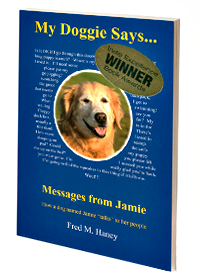
What a great way to bond with your doggie during the summer! Swimming in Lake Arrowhead was Jamie’s (My Doggie Says…: Messages from Jamie. How a dog named Jamie “talks” to her people) favorite thing in all the world, and I can now see that Callie won’t be far behind.

Callie Learns to Swim

Sunday, July 1st, 2007

This is partly an experiment in getting video into this blog. Hope it works. This video is from three weeks ago when Callie, on a long leash, made her first attempts to swim. There are two parts to the video. In the first part you see the native intelligence of a Golden Retriever at work. Callie grabs the rope attached to her fetch toy and just pulls the toy ashore. But in the second half of the clip, Callie actually takes a few little dog paddles before getting back to the beach.

You can see Callie being a little afraid of the waves and afraid of getting into water “over her head.” Actually, this is a reason we wanted to work with Callie when she takes her first few puppy paddles. We know of a few dogs that had bad experiences learning to swim and decided never to swim again. We don’t want this to happen to Callie.

[youtube=http://www.youtube.com/watch?v=eKIL0V1ExnE]

Yesterday, we headed down to Callie’s beach at Lake Arrowhead. Near our boat dock, we met Jack, a six-year-old boxer, and Maverick a six-month-old yellow lab. Maverick was a lot bigger than Callie, even though they are about the same age. We are expecting Callie to be on the small side for Golden Retrievers. Her mom weighs about 55 pounds, but her dad is large. We’re giving Callie a totally loose leash when she visits other dogs, so she can work things out in her own doggie way. So far, it’s working. With Jack, the boxer, Callie was totally submissive. She just flattened herself on the ground in front of Jack. With Maverick, she acted more like an equal.

The toy you see in the video above is an “indestructible” piece of firehose with a little fabric loop for a leash, so you can throw the toy into the water & retrieve it. Well, in the intervening two weeks, Callie has managed to destruct the indestructible. She didn’t damage the firehose part, but she chewed through the fabric loop, so we can’t attach a leash to it.

We tried tossing the blue toy without a leash, but the water was too deep for Callie. Besides, the blue toy kept floating farther from the shoreline. So we decided to teach Callie to swim the old fashioned way — with a stick. I grabbed a small pine stick and tossed it into water that was just deep enough that Callie would not be able to walk to it. She stopped walking when the water got up to her nose, and she obviously wanted to retrieve the stick. She dug deep inside for a little courage and pushed off the bottom toward the stick. This first time, her head went under water for just a second, but she got the stick and took a few paddles back to land.

That was all it took. The next three or four times, Callie took a few paddles to get to the stick, grabbed it, and paddled back to shore — definitely swimming. She is still a little hesitant before taking the plunge. She stops for a second and then screws up her courage to jump in, but now she does it every time.

I didn’t have the video-cam yesterday, but I’ll get some shots of Callie now that she’s an expert swimmer.

Also, it will take a little editing, but now that I know how to do video, I’ll put together some clips of Callie playing soccer.

Doggie Toy Talk

Wednesday, June 27th, 2007

Callie is doing something that Jamie used to do. Sometimes, she’ll bring me a toy and then not let go of it. If we’re really playing “fetch,” I can pry it loose from her puppy mouth. And sometimes she lets go easily, or even drops the toy in front of me. But sometimes she just holds on, so that I would have to work hard to get her to let go. I don’t feel like I need to win all these little battles, so sometimes I let her have the pleasure of “winning” and she walks away with the toy. Someone might say I’m not being alpha enough, but I think it’s good for her to win a few little battles — if, in fact, it is a battle. It might just be a little game.

I really like it when Callie initiates play, which she does quite often. This seems to show some special intelligence, so I try to reward it. She will bring me a toy and invite me to give a toss so she can play “fetch.” She will often do this a dozen times without getting bored with the game. Then she takes the toy off to another place and plays by herself.

These little “toy games” seem to send some messages, but I’m not sure I always understand. One message is “come play with me.” Another might be “I am glad to share my toy with you for a minute, but I don’t want you to take it or throw it right now.”

This past weekend, Callie made several attempts to share her toys with Ishka. One time, she pushed a toy into Ishka’s face, clearly inviting Ishka to play. But Ishka, being 12 1/2 years old and a little grumpy, barked loudly at Callie. I don’t know that this was an alpha bark. It might have been an I’m-old-and-tired-and-you’re young-and-a-nuisance bark. Anyway, poor Callie raced straight to me for refuge.

Another time, Callie took her favorite stuffed doggie to Ishka and simply dropped it at Ishka’s feet and walked away. It seemed like an extremely signigicant wolf-pack kind of gesture. Again, I’m not sure if it was an intentional sign of submission, or a wonderful recognition of Callie’s sweet old friend.

At times, I’m amazed at Callie’s ability to entertain herself with her toys. There may not be much of an intentional message here, but her behavior certainly suggests that she’s happy playing with her toys. She has a few “fetch” toys that are made to be thrown and retrieved. Sometimes she flips them around really hard — at times so hard that she ends up launching them across the room. Like I’m supposed to be the retriever? At other times, she just seems to enjoy just chewing gently on a toy.

Jamie had several toys that seemed to be “snuggle” toys. She didn’t really chew on them or do anything; she just liked to have them close — like a few inches from her nose. For hours on end sometimes.

Finally, at the end of a day, when Callie is tired, she often spends ten or fifteen minutes just quietly and gently nibbling on a toy. She’s almost just “gumming” it. She often does this with her favorite little stuffed doggie. This is a clear sign that she is tired and ready to go to bed.

Callie and Ishka visit Lake Arrowhead — all about alpha

Sunday, June 24th, 2007

This weekend we’re dogsitting daughter Karen’s Golden Retriever, Ishka (short for Uisgebagh, which is Gaelic for whiskey). Ishka, you will remember, if you read My Doggie Says…, was Jamie’s best pal. Ishka and Jamie were born within a few weeks of each other, and they were best friends right from their puppy days. Sometimes they played so hard you thought they would just melt into a little puppy puddle. At 12 1/2 years-old, Ishka goes pretty slow, so it’s interesting to watch the interaction between 6-month-old Callie, always full of puppy energy, and Ishka.

Here’s a photo from My Doggie Says… of Ishka (on the left) and Jamie at Lake Arrowhead.

final-pdfs-for-book-041-2.jpg

But first two news items of importance:

The LA Times has an article today about using DNA testing to determine the genetic makeup of mutts. (“Decoding the secret lives of dogs,” LA Times, June 24, 2007.) If you’re really interested in understanding your dog — and nurturing it — this seems like a great idea. If you’re not sure about your dog’s genetics, why not find out? It seems like it could only help you understand your dog’s personality a little better.

On a tragic, and somewhat personal note, the Daily Breeze (serving the South Bay area of Los Angeles) has a very sad story today: El Segundo police dog killed in hit and run. The Dutch Shepherd, Basco, was a five-year veteran and hero of the El Segundo police department.

Somtimes things come together in strange ways. In March, I was the emcee for a dog walk in Redondo Beach called “Fido and Friends.” It was a fundraiser for the Wellness Community, a wonderful organization that serves cancer patients. Basco, the dog who was killed yesterday, was the star of “Fido and Friends.” He and another Dutch Shepherd gave a demonstration of their skills. The other dog’s handler, a different Officer Ken, is a friend of mine, and it turns out that last year he, too, lost a magnificent dog in a tragic accident. To put a final note on all this sadness, I saw (the other) Officer Ken Thursday night, at the viewing for our mutual good friend and shared veterinarian, Dr. Chris Omoto Beezley.

We’re all bonded to our pets, but imagine the bond and trust between our police officers and their canine pals. There are times when the lives of both man and dog depend on doing exactly the right thing at the right time. So, Officer Ken, we share the loss of a very special veterinarian and a very special dog.

On a cheerier side, we picked up Ishka on Saturday morning for the ride to Lake Arrowhead. Callie was all strapped into the back seat of our car with her puppy safety harness, but she had lots of room to maneuver. So when I lifted Ishka onto the car seat, Callie — in her puppy jubilance — jumped on Ishka and got her puppy harness hopelessly tangled up with Ishka and Ishka’s leash. Total puppy spaghetti!

Once we got the puppy spaghetti sorted out, we made our way to Lake Arrowhead, which is about a two-hour drive from Karen’s house. In the winter, it’s often around fifteen or twenty degrees cooler here at 5,000 feet elevation, but in the summer the daytime temperatures are about the same as down below. The air is refreshing and it’s a great place for doggies.

It’s a great place for doggies, so long as they stay away from the coyotes. There are plenty of coyotes around; we don’t see one every time we come here, but they’re not scarce. So it does seem a little strange that we spotted coyotes on our property twice yesterday. Callie’s always on a leash, but the coyotes may be paying attention.

Callie spotted something last night, when she was out on our deck, and she barked her first bark! It was probably either a racoon or a coyote — we didn’t see it — but Callie did. We were starting to wonder if she could bark. Now we know. At almost six months old, she has a great Golden Retriever bark.

These days the dynamic between Callie and Ishka is pretty much Callie trying to initiate play and Ishka saying “bug off!” And Callie’s very respectful. She tries a few times to get some play started, and then she goes about her business. I don’t know if this is because Ishka is the alpha animal, or because Callie just respects her elders. But last night Callie did something very cute — probably quite symbolic in a wolf pack world: She carried her favorite toy (a little stuffed dog) over to where Ishka was lying, and she dropped it right at Ishka’s front paws. And then Callie walked away and started to play with another toy. In the wolf pack world of alpha dominance and submission, this must be pretty close to the ultimate message that a doggie can send.

The mechanics of dog body language

Friday, June 22nd, 2007

Most of Jamie’s “messages” in My Doggie Says… were based on a behavior. She would walk to a door, or stop and make eye contact. Or adopt a specific posture in a particular location. Her behaviors were acted out, and my challenge was to figure out what she meant by each one.

Here’s an example of Jamie standing in front of her puppy treat jar and making a polite request for one of the flavor gems.

ch2_0024-2.jpg

Traditionally, though, dog talk has been interpreted in terms of how the dog wags its tail, holds its ears, pants, shows its teeth, and other specific body actions. Here are two good short articles on how to interpret this kind of dog body language: 1) Dog Communication (from Wikipedia) and 2) How to talk — and listen — to your pets (by Kim Campbell Thornton, MSNBC Contributor).

The Wikipedia article explains how a dog’s tail, teeth, ears, mouth, eyes and eyebrows, feet and legs, and head can send messages about its mood or aggressiveness.

As we discussed in an earlier blog, dogs are really into signalling their dominance, or submissiveness, over other dogs. This article explains that dogs sometimes signal their confidence, or degree of dominance, by how high they hold their tail, some even curling their tail up & over their back. This might be something to pay attention to with your dog.

Kim Campbell Thornton’s article also talks about tail wags and the messages they can send. A peppy tail wag can be friendly, whereas a slow steady tail wag can signal aggressiveness.

This article also suggests that establishing your dominance over your dog, as the alpha animal, can be over-rated. Being dominant in the relationship doesn’t guarantee that your dog won’t engage in problem behaviors.

I still like Amy’s comment from June 12: “Benevolent but Alpha.”

What is your dog thinking?

Thursday, June 21st, 2007

This article by Rob Stein, Washington Post Staff Writer, describes some fascinating experiments that suggest that dogs are smarter than scientists have thought. (What Were They Thinking? More Than We Knew. Washingtonpost.com, Monday, June 4, 2007)

The article describes an experiment performed at the University of Vienna. First, it was demonstrated that fourteen-month-old children imitated adult behavior, but only under certain circumstances. Then, a similar experiment was done with dogs. The scientists trained a Border Collie named Guinness to get a treat by pushing a wooden rod with her paw. Usually, a dog would do this with its mouth.

A group of dogs that saw Guinness push the rod while holding a ball in her mouth decided to push the rod with their mouths, because they concluded that Guinness was using her paw only because her mouth was busy. But the dogs that saw Guinness push the rod with no ball in her mouth concluded that this was the best way to get the treat, so they used their paws to push the rod.

The scientists were amazed that the dogs’ thought process was similar to that of the fourteen-month-old human children.

Many studies have tried to assess the “intelligence” of dogs. They all seem to conclude something like “dogs can’t work a Rubik’s Cube, so they must not be very smart.” Yet just being around my own pets, I’ve always felt that they were smarter than the scientists thought. Jamie (My Doggie Says…: Messages from Jamie. How a dog named Jamie “talks” to her people) really brought this home for me. She did some things that seemed to me to require a lot of intelligence.

Much of our intelligence comes from our brains’ ability to “associate” objects, ideas, places, images, people and other things. Jamie clearly had this ability. She could remember every jogging path we had taken. And she had her preferences. She knew, for example, which way to turn to get to our boat dock, which was her favorite place at Lake Arrowhead, because it was her place to swim. Here she is pulling us in the direction of our dock.

final-pdfs-for-book-091-2.jpg

But even more amazing to me was the whole sequence of events leading up to an outing to our dock. It started with my green backpack (full of flashlights, bottle openers, etc.) coming out of the hall closet. As soon as Jamie saw it, she would get a big drink of water and sit by the front door waiting for us to get in the car. When we parked the car, she would pull us to the correct path. Then she would pull us to the correct dock. Then she would stand by the storage box that contained her floating “floppy disc.” Not just by the storage box, but at the exact place where she knew her “floppy” was stored. Then she would carry her “floppy” to the gate and wait until someone opened it so she could run down the gangway. Then she waited for one of us to throw her “floppy” into the lake so she could retrieve it. Then she would swim and swim and swim until we knew she had to stop.

This may not be a scientific proof that Jamie was “smart,” but it was pretty convincing to me. It was a complex sequence of events that she was able to work through in order to do one of the things that she was bred to do and one of the things that she loved more than anything else in the world — to retrieve her “floppy” and swim in the lake.

ch13_000b-2.jpg


Deciphering Dog Talk

Wednesday, June 20th, 2007

Here’s an example, from My Doggie Says…, about how you have to figure out what your dog is saying sometimes.

One morning, Barbara’s picture was in our local newspaper. So on our morning jog, Barbara, Jamie and I went to a vending machine to buy four copies of the paper. I rolled them up into a bundle and started to carry them home. The jog home is about one mile up a pretty steep hill.

As we ran up the hill, Jamie kept slowing down and looking back at me. I wasn’t sure what she was thinking, or “saying.” Barbara said, “I think she wants you to pay attention to her. Try giving her a little head scratch.” So I stopped and gave Jamie a little love, and off we jogged again. But Jamie kept looking back at me.

I tried the “head scratch” a few more times, but Jamie kept slowing down and looking back at me, making eye contact.

Finally, Barbara said, “Maybe she wants to carry the newspapers.” So I stopped and put the roll of newspapers in Jamie’s mouth. She raised her head a little to show how proud she was, and she carried the papers the rest of the way home.

Looking back, maybe it should have been obvious. After all, what would a Golden Retriever want to do more than “retrieve?” But it’s not always easy to figure out what a dog is saying. You have to look for clues and keep thinking “what could he/she be thinking?” I think this is a good example of how you can do a better job of nurturing your dog if you learn what it is bred to do and what it likes to do.

ch18_001d-2.jpg

In this case, we didn’t need to analyze what was happening with her ears or her tail. As is often the case, the message is sent with an action. Often, an action that seems a little out of whack. It makes you wonder “why is she doing this?” There’s often an answer, but sometimes, only the doggie knows for sure.

My puppy bed should be on the sofa, too!

Sunday, June 17th, 2007

Okie-Dokie, a really neat black cat, adopted us about eight years ago. Okie-Dokie is neat because she’s a very worldly indoor/outdoor cat. She has a bit of a sordid history, starting life as a ferrel cat. She was adopted and neutered by a family in our neighborhood, who later had a baby. When their second baby arrived, Okie-Dokie (whose name, we discovered later, was Maxine) decided she wasn’t getting enough attention, so she started hunting gophers in our yard. After a few weeks of feeling her way around, she decided to move into our house, and she’s been here ever since. She’s a good indoor cat, but she is also savvy about cars on the street, and she’s a good mouser.

When Okie-Dokie was checking us out, we did not know who she was, or any of her history. We learned it later, when someone from the neighborhood saw Okie-Dokie and said, “That’s Maxine.” So then we got the whole story, and Maxine’s parents are glad for her to have a happy home.

Okie-Dokie has a nice sheepskin bed on one corner of the sofa in our den. She doesn’t always sleep there, but she does sometimes and it’s a great place to hang out.

Last night, Barbara washed Callie’s sheepskin puppy bed and put in in the hallway so she would remember to carry it in to Callie’s crate. (Callie is a five-month-old Golden Retriever puppy, still crate training.) We turned our backs for just a minute to get dinner ready, and when we walked into the den, Callie had carried her puppy bed into the den and put it on top of Okie-Dokie’s bed on the sofa!

Where do puppies get ideas like this?

I don’t think the wolf pack taught them where to put their puppy beds, did it? Is this a way of competing with Okie-Dokie for the Alpha position in our family? Maybe she just thought the sofa was the place for sheepskin beds.

Our pets’ behavior often mystifies me. I try to understand, but there are times when I get frustrated and wish I could look inside their minds. Callie seems to have had some kind of reason for putting her bed on top of Okie-Dokie’s. We thought it was incredibly cute, but we also wondered what she was thinking.

Callie has been confronting Okie-Dokie a little lately. When she first arrived at our home, she was an eight-week old puppy weighing seven pounds. But now she’s five months old, and she weighs about thirty-five pounds. At first, Okie-Dokie showed Callie who was boss with a few pokes at Callie’s nose. And Callie became very submissive. But now much larger than Okie-Dokie, Callie seems to be saying either “you can’t beat me up any more” or “let’s have some rough play.”

So maybe Callie put her bed on top of Okie-Dokie’s to prove her superiority. Or maybe she just did it.

It’s a mystery.