Archive for the ‘Books’ Category

Do You Have a Meaningful Relationship with Your Dog?

Sunday, December 16th, 2007

Ever wonder what it means to have a “meaningful relationship” with your dog?

It’s easy to get caught up in the mechanical aspects of owning a dog. You feed the dog, walk the dog, and train it not to pee on your carpets. And you work on obedience training — teaching your dog to “sit” and “stay” and “heel” and “come.”

Maybe the ultimate “mechanical” experience is owning a robot dog like Aibo. (Click on the image to see a BBC article about Aibo.)

_1536962_aibo_300.jpg

This is sort of old news. You’ll notice the date on the BBC article is 2001. But it’s an interesting experiment in understanding the difference between a “robotic” relationship with a dog as opposed to an “emotional” relationship.

Aibo, developed by SONY, had some pretty cute features. You could program his software to change his name. And you could hook him up to your computer to see the world through his eyes. But the author of this article reaches this conclusion:

No further connections grew between us, and I grew increasingly frustrated with my inability to develop a mutual relationship with Aibo.”

Here’s the final chapter of the Aibo story. Sony cancelled the project in 2006, partly because people wanted more than a robot for a pet.

It’s possible for owning a dog to become robotic and boring. For example, if you don’t like to walk, then walking your dog can be a burden. But for people who do like to walk for exercise, walking a dog can be a pleasure. The walk can be a shared experience.

What does it mean to have a relationship with your dog? Well, it must have something to do with getting past the boring, robotic chores. Here are a few ways that your dog relationship can get past the mundane stuff:

  • You actually enjoy walking your dog, and the walk becomes a shared experience — and you and your dog get healthier in the process.
  • You find other shared experiences, like going to a dog park, or in the case of Callie, playing soccer.
  • You discover some things that your dog really likes to do, or is bred to do, and you take pleasure in supporting your dog’s “hobbies.”
  • You get into competitions with your dog, like dog shows, agility training, or dog dancing.
  • You tune into the more subtle “messages” that your dog is sending, and start to “speak” its language.
  • You discover that your dog, in addition to depending on you for lots of things, also really cares about you — likes to be in the same room, licks your wounds and wants to sleep on your bed.

These are just a few of the ways your dog can capture portions of your heart and soul, if you let it.

Here are two of my favorite images from “My Doggie Says… Messages from Jamie.” The first is a photo of Jamie lying across the hallway by my home office saying, “I’m going to do everything I can to keep you right here.”

final-pdfs-for-book-035-2.jpg

The second, is a photo of Jamie getting excited because she saw me take my green backpack out of the closet at our Lake Arrowhead house. Jamie knew that this meant she was going to get to go swimming in the lake, which was her favorite thing to do. So she sat by the door, waiting patiently (well, not always so patiently) to go to the lake.

ch13_0008-2.jpg

Why would you want to have a “meaningful relationship” with your dog? After all, it will affect you emotionally — sometimes in happy ways and sometimes in sad ways. From the dog’s point of view, you are making its life better by sharing a part of yourself. But you’ll find that you grow in unexpected ways, too. For example, I got so interested in Jamie’s “dog talk” that I took hundreds of photos and wrote a book about it (“My Doggie Says…”). In many ways, the book — and the ensuing experiences — were a gift from Jamie.

The ultimate test of your emotional connection to your dog, of course, comes when you lose it. It’s been exactly a year since Jamie left us, and it’s still not something I want to write about. I treasure the times we had together, and I know that she was a better dog and I am a better person because of them.
Help Your Retriever Retrieve (with video of Callie)

Monday, December 10th, 2007

If you want to have a good relationship with your dog, one of the best things you can do is to help it be true to its breeding and nature. For example, Golden Retrievers are bred to retrieve. So why not give your Golden Retriever lots of chances to retrieve different things?

If you’ve read “My Doggie Says… Messages from Jamie,” you know that Jamie would often interrupt our morning jog by freezing in place and looking back at us to make eye contact. The message was, “Could I please pick up this pine cone and carry it for a while?” We encouraged her to retrieve things (usually pine cones or sticks) whenever she could.

Of course, her favorite thing to retrieve was her “floppy.”

Callie, now almost eleven months old, is building her retrieving muscles. It’s fun to watch her, because she doesn’t always know what works and what doesn’t work. For example, Jamie learned that it works best to carry a big stick by holding it near the middle, so it balances evenly.

You’ll see in the video that Callie hasn’t quite figured this out yet. She often “bites off more than she can chew,” trying to retrieve sticks that are too big and then holding them at one end, instead of in the middle. But she’s learning. And it’s really fun to watch her work at being a better retriever.

Dogs are Smarter than we Thought (Surprise!)

Saturday, December 1st, 2007

Slowly, but surely, the scientific community is catching up with us dog-lovers who know that dogs are smarter than most people (especially scientists) think.

In the past, the logic has gone something like, “Dogs can’t work a Rubik’s Cube, so they must not be as smart as people. Or, “Dogs can’t solve math problems, so they aren’t very smart.”

But most of us who own dogs — and have had close relationships with them — know better. We’ve watched our pets solve hard problems, like “How do I get the dog treat (or a carrot, or some sting cheese) out of the Kong toy?” Callie was doing this today, in her crate, by picking up the Kong toy and dropping it on the floor of the crate, with a big “thump.” Sometimes, when she dropped the toy, the food would stick out a little more, and Callie would grab a lick or a bite. It sounded like someone playing basketball, with the constant “thumping.”

Jamie’s favorite thing to do was to swim in Lake Arrowhead and retrieve her “floppy disc,” a pink, floating frisbee-like toy. This was one of the most fun parts of writing “My Doggie Says… Messages from Jamie.” Because it revealed Jamie’s ability to work through a whole sequence of “problems,” in order to do what she wanted to do more than anything else in the world.

It started when I took my green backpack out of the front closet.

ch13_0008-2.jpg

This was Jamie’s signal that we were going to the lake. Next, Jamie would wait by the door until we took her to the car. Once we arrived at the lake, she literally dragged us step-by-step to our boat dock, which she could distinguish from the other boat docks. She knew right where it was. Then she walked to the west dock-box (not the east one) because she knew her Floppy was in that one. Then she stood and waited until I opened the dock box and got her Floppy.

Once Jamie had her Floppy in her mouth, she stood by the gate, waiting for me to open it. Then she ran down the gangway and dropped her Floppy on the boat dock, until I threw it into the lake. Then, finally, she jumped into the lake and retrieved her Floppy, which was her absolute favorite thing to do. But she had the whole process orchestrated, from the minute the green backpack came out of the closet.

ch13_000b-2.jpg

So we know dogs are very smart.

The good news is that science is finally catching up with us. Friederike Range and his colleagues from the University of Vienna, Austria, created an experiment that demonstrated that dogs could be trained to recognize the concept of “dog.” After a training phase, the dogs were able to distinguish between photographs of dogs (different shapes, sizes and numbers) and photographs of scenic landscapes. So the dogs were able to understand the concept of “dog.”

Here, from Science Daily, is an article that describes the experiment. And here, from Britain’s “Telegraph,” is another version.

What’s the smartest thing your dog does? Pay attention to how it solves little problems, and you’ll have a greater appreciation for its intelligence.

A New Mascot and the Intelligent Dog

Monday, November 12th, 2007

One of my alma maters, Carnegie Mellon University, has announced a new mascot. In keeping with its Scottish heritage, the university unveiled the profile of a feisty looking Scottish Terrior, complete with Scottish plaid neckware, as its new mascot. Read about it here. Here’s a picture of the new mascot:

cmu-mascot.png

The job of mascot is one that Callie forgot to mention in her October 4, 2007, post, “Top Ten Jobs that Dogs Could Do.”

I still think that dogs are smarter than we think. Here’s an article on “Dog intelligence” from Wikipedia. Does this do the subject justice? I’m not sure it does. The focus is on how well dogs solve problems, or how well they can be trained. It seems to me that dogs have intelligence that goes beyond this.

Every morning on our walk, we stop on a certain bridge for a water break. At first, we trained Callie to “touch the bridge” with her paws. When she did, she got a treat. But now, she touches the bridge without a command (just like Jamie did), knowing that she’ll get her puppy treat. So who’s training who? And who’s the smart one?

Callie invited me to play soccer with her the first day she came home to our house, at age eight-weeks. She now has me trained to play soccer with her every time we’re in the back yard. Who’s the smart one?

One thing most discussions of dog-intelligence are missing is their ability to “sense” what’s going on around them and act upon it. Whether because of their acute sense of smell or hearing, or other senses. I suppose dog-intelligence is different from human-intelligence, but I find it just as amazing.

The Assertive Dog (Callie)

Saturday, November 10th, 2007

So much of dog training — and training people to train dogs — is about getting your dog to obey your commands. This is important. There are times when your dog’s safety depends on obeying a command.

Another theme in dog training is establishing yourself as the alpha pack animal. This helps make life unambiguous for the dog; it knows where it stands in the family order.

That said, I don’t think it’s necessary to train every spec of creativity, initiative, or assertiveness out of a dog. I like a dog that is pleasantly assertive. I don’t know how to train this into a dog, if it doesn’t already have it. But I do think it’s possible to train it out of a dog by being too alpha and too focused on obedience.

Callie’s showing some signs of assertiveness, and we’re glad to reinforce them, within limits. Actually, when she first came to our home, at age eight-weeks, she invited me to play soccer (by sitting behind a soccer ball), and I complied. My compliance surely encouraged her to keep inviting me to play soccer. Which I really like.

The other day, Callie was enjoying her freedom in my office, and I decided to let her walk, without her leash, out to pee. Se we headed for the side yard. But first Callie stopped, picked up her kong toy, and made eye contact, as if to say, “Is it OK if I bring this?” I like to honor her requests, but, knowing how easy it would be for the toy to get lost in the ivy, I decided it was a bad idea.

So off we went to the side yard without the kong toy. But as soon as I opened the door, Callie exploded into a barking, running and slamming-into-the-wall frenzy. Our neighbor’s cat had been basking in the sun atop the wall, and Callie decided to chase her away. Which is fine with me. 🙂

Then, as we walked back to my office, Callie stopped at the sliding glass door to the back yard. The door was open just enough for Callie to get her nose through the opening, but not enough for her to walk through. She stopped and looked right at me. The message was very clear. “Could we please play soccer for a few minutes?” I managed to catch her in action in this photo:

img_0268-2.jpg

I couldn’t say “no,” so we played soccer for a while. After all, she made such a polite request.

Then, I decided to let Callie join me for a little practice in my golf net. Jamie used to do this all the time. Here’s a photo of Jamie from “My Doggie Says… Messages from Jamie: How a dog named Jamie ‘talks’ to her people.

ch2_0025-2.jpg

But Jamie was not a ball dog, and Callie definitely is a ball dog. So the minute Callie saw the golf balls, she collected two of them in her mouth. She really wanted to chew the golf balls, but I worry about the materials and the possibility that she could swallow one of the balls. Not good. In the end, I had to decide that golf practice wasn’t going to work for Callie, at least not until she matures a little more.

I’m really glad that Callie is asserting herself. She does it in a nice way, but she makes her wishes known. It’s fun to reinforce her assertiveness, when it’s safe and when it doesn’t get out of control.

It seems to be working to let Callie be assertive at times. We still let her know who’s boss, and we continue to insist on obedience. Somehow, I think she understands.

Book Review: "On Talking Terms with Dogs: Calming Signals," by Turid Rugaas

Sunday, November 4th, 2007

Our doggie “best friends” send messages at different levels. “My Doggie Says… Messages from Jamie: How a dog named Jamie ‘talks’ to her people” is about some of the “big” messages that Jamie sent. “Big” meaning that it was her action or behavior that sent the message. She would sit by a door to ask to go out. Or bark when it was time to go jogging or go to the lake to swim.

Most of us also know that our doggie friends send messages with their tails, ears, posture, and eyes. Having read “Calming Signals,” I would call these message “middle-sized” messages. For example, some tail wags are friendly and some are not. “Ears up” sends a different message than “ears down.”

Turid Rugaas, in her wonderful little book “On Talking Terms with Dogs: Calming Signals,” (Dogwise Puslishing) describes some “little,” or subtle messages that dogs send. Her observations of dogs (and wolves) led her to identify over thirty “signals” that dogs use to “calm down the pack.” They are signals that are used to head off aggression, reduce tension, and generally help the pack keep the peace. Interestingly, some of these signals can be used by humans to send messages to their dogs.

These signals are sometimes quite subtle, so you have to watch for them. But I found that once I was aware of some of them I got better at spotting them. For example, actions like a quick lick of the lips, or a sideways turning of the head are meant, by the dog, to say something like “cool it.” The same is true of a doggie yawn or simply turning away. Another is “softening of the eyes,” or a partial squinting of the eyes.

One of the charming themes of this book is that Turid’s own dog, Vesla, was a master at using these techniques to help calm other dogs, including Turid’s clients’ dogs who had various behavior difficulties. Vesla had a sense about what was causing the problems, and she was able to use the “calming signals” to communicate with the troubled dog and help it eliminate the undesirable behavior.

I was quite surprised, after reading the book, to observe how frequently my Golden Retriever, Callie, was telling me to “calm down.” I would walk down the hallway toward her crate, look her in the eye, and say something like “Hi, Callie, how’s it going?” And she would often respond with a quick nose lick, a turn of the head, or a yawn, indicating that my frontal approach was causing her some stress. So I’m working on modifying my own behavior.

When dogs meet, they don’t make eye contact and head straight for each other. This is considered aggressive behavior. They glance away. They “curve,” meaning that they approach each other in a circular path. Then, having established a non-aggressive relationship, they proceed to interact.

One of the fun and fascinating aspects of “calming signals” is that some of them can be used by humans. For example the sideways glance, turning of the head, and yawning are all signals that a human can use to say, “let’s stay calm.” The other day, I yawned at Callie a few times, and, wouldn’t you know it, she yawned back at me!

“Calming Signals” has lots of great color photographs. I also purchased a DVD version which is fun, because you see video of dogs sending the “calming signals” back and forth.

If you really want to know what your dog is telling you, pay attention to the “big” messages, the “middle-sized” messages, and the “little messages” (i.e., the calming signals). You’ll gain a better understanding of your dog, and you’ll be able to actually start talking “dog.”

"My Doggie Says…" is an award-winning finalist in the Animals/Pets:Novelty category for the National Best Books 2007 Awards

Friday, November 2nd, 2007

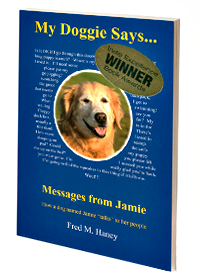
My Doggie Says …Messages from Jamie. How a dog named Jamie ‘talks’ to her people” received it’s third award on Thursday, November 1, 2008. It was announced as an award-winning finalist in the Animals/Pets: Novelty category of the National Best Books 2007 Awards. Here are some excerpts from the press release:

LOS ANGELES – USABookNews.com, the premiere online magazine and review website for mainstream and independent publishing houses, announced the winners and finalists of THE NATIONAL “BEST BOOKS” 2007 AWARDS (BBA) on November 1, 2007. Over 500 winners and finalists were announced in over 140 categories covering print, audio books & courses, e-books and interactive CD-ROMs. Awards were presented for titles published in 2007 and late 2006.

Jeffrey Keen, President and CEO of USABookNews.com, said this year’s contest yielded an unprecedented number of entries, which were then narrowed down to over 500 winners and finalists.

Keen says of the awards, now in their fourth year, “The 2007 results represent a phenomenal mix of books from a wide array of publishers throughout the United States. As an executive in the publishing PR and marketing industry and president and CEO of JPX Media, I wanted to create an awards competition that recognized books in their publication year rather than months after the original launch window. With a full publicity and marketing campaign promoting the results of BBA, this year’s winners and finalists will gain additional media coverage for the upcoming holiday retail season.”

Winners and finalists traversed the publishing landscape: Simon & Schuster, Penguin-Putnam, HarperCollins, Random House, McGraw-Hill, Houghton Mifflin Co., John Wiley & Sons & hundreds of independent titles contributed to this year’s outstanding BBA competition. Keen adds, “BBA’s success begins with the enthusiastic participation of authors and publishers and continues with our distinguished panel of industry judges who bring to the table their extensive editorial, PR, marketing, and design expertise.”

USABookNews.com is an online publication providing coverage for books from mainstream and independent publishers to the world online community. USABN Magazine Online is the monthly electronic magazine e-mailed free to a large cross-section of the book buying public. JPX Media, in Los Angeles, California, is the parent company of USABookNews.com.

A complete list of the winners and finalists of the USABookNews.com National “Best Books” 2007 Awards is available online at http://www.USABookNews.com.

My Top Ten Toys (By Callie)

Tuesday, October 30th, 2007

img_0231-2.jpg

Hi! This is Callie writing. Fred’s been up in Silicon Valley for a few days, so he asked me to fill-in. Happy Halloween!

I thought I’d share with you how I feel about some of my toys. First, here I am with a few of my favorites — my stuffed trout, my favorite “stinky,” my black and yellow barbell, and my (now legless) dodo bird.

img_0195-3.jpg

So here are my Top Ten favorite toys:

1. Black and yellow soft barbell is pretty fun. It feels good to chew on, and it’s heavy enough that I like to flip it back and forth.

2. Little stuffed bear. This little guy can be pretty relaxing to just munch on — very gently. I don’t want to hurt him, so I don’t ever bite hard. It’s almost as good as my “stinky” for calming down in the evening.

3. The new funny little thing with rope loop handles. This is a new toy that Fred and Barbara bought me last week. I don’t know what to call it. It has about three very hard, colored circles of rope that act like handles. So it’s a really good toy for playing “give and take” with Fred. I offer it to him and he grabs hold, but he doesn’t pull hard. He just holds on for a minute, and then he lets me take it. I really like it when we do this.

4. Green jacks. This one is about eight inches square, and it looks like one of those little metal “jacks” that kids play with — it has four little sticks with knobs on the end. I like this one because it’s easy to grab in my mouth. But it’s not a real good chew toy; there isn’t much to hold on to.

5. Orange fire hose toy. Some doggie toys are made out of old fire hose, so they’re supposed to be indestructible. Well, the fire hose is pretty tough, but the handles they put on these things are easy to chew through. So all my fire hose toys are just fire hose these days. These are really good for flipping back and forth. I like to play with my toys this way sometimes. I get them flipping back and forth real fast and then, if I time it right, I can launch the toy clear across the room!

6. Stuffed trout. This isn’t the kind of stuffed trout you’d eat for dinner. It’s the kind of doggie toy that is stuffed to make it soft for a doggie. It’s pretty amazing that I haven’t chewed through this one, because it’s one of my favorites. I spend a lot of time with it, but it’s tough. This is a good “flipper” toy, too. When I get it going real fast, it looks just like a trout jumping in Lake Arrowhead.

7. (Legless) Dodo Bird. My legless dodo bird isn’t supposed to be legless, but it is. The legs were made of rope, and I un-ravelled them a few weeks ago, so Barbara just cut them off. But I still like the dodo bird. It’s good for cuddling, and sometimes I use it like a pillow in my crate.

8. Soccer ball. This is one of my favorites, because it’s something I can do with Fred. When he lets me out in the back yard, I run right to it, and invite him to play soccer. Fred kicks the ball, and I run fast and trap it under my tummy. Then he kicks it loose, and I run and trap it again. Sometimes he throws it real high, and I jump way up in the air and bump it with my nose. It’s really good exercise!

img_5353-3.jpg

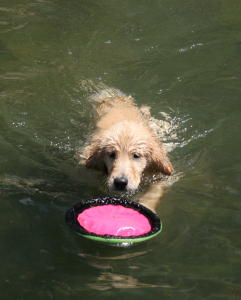
9. Floppy disc (water frisbee). Boy, we’re really getting to my favorites now. This is the “floppy” (just like Jamie’s in “My Doggie Says…“) that I retrieve when I swim at Lake Arrowhead. After all, please remember I am a Golden Retriever. I’m not as good as Jamie yet, but I really love to swim and retrieve this floppy.

img_6121-4.jpg

10. So here we are at my absolute favorite — my “stinky.” Fred calls it my “stinky” because that’s what his granddaughter, Lauren, calls her security blanket. My “stinky” is a little stuffed puppy that belonged to Jamie. I’ve enjoyed it ever since I moved in with Fred and Barbara in March. It’s pretty amazing that it’s survived all this time, but I’m very gentle with it. I don’t really chew on it. It’s more like “gumming.” Sometimes I like to hold it in my mouth and just nibble at it a little. It’s very relaxing. Most nights, when I’m about ready to go to bed, I settle down with it. It helps me calm down after bouncing off the walls.

11. (For good measure) This one is so much like food it’s unfair to call it a “toy.” It’s a kong toy. It’s a small, hard chewie thing with a hole in the center for dog food or puppy treats. I can chew on it, but the real challenge is to try to get the puppy treat out of the hole. Like I said, it’s too much like food to really qualify as a toy.

So there you have my favorite toys. See ya’ next time!

"My Doggie Says…" wins second award

Wednesday, October 24th, 2007

My Doggie Says… Messages from Jamie. How a dog named Jamie ‘talks’ to her people” won its second award — Honorable Mention for non-fiction in the 2007 DIY Book Festival. The winners are listed at the DIY Book Festival Site.

In June, “My Doggie Says…” was announced as the Winner of the Animals/Pets category for the 2007 Indie Excellence Award.

The 2008 DIY Book Festival is part of the DIY Convention: Do It Yourself in Film, Music & Books, which also produces the DIY Film Festival and the DIY Music Festival. The 2008 DIY Book Festival is sponsored by The Hollywood Creative Directory; Shopanista and The DIY Reporter.com.

The Indie Excellence Awards are sponsored by PubInsider.com, a public relations and marketing firm located in Los Angeles, California.

How Do You Calm a Puppy?

Friday, October 19th, 2007

I wish I knew the answer to this question. I’m sure part of the answer is, “If you wanted a calm dog, why did you get a puppy?”

Well, I know that puppies are puppies. They are wonderful, furry, energetic little bundles of energy that eat and drink and grow and give enormous pleasure to their people.

Of course, we’re talking about Callie here. And I know that the number one way to calm a dog is to make sure it gets plenty of exercise — which Callie does. She goes for a three-mile walk almost every morning. And I try to play soccer with her a few times a week. She’s improved since this video was taken, but it gives you the idea.

httpv://www.youtube.com/watch?v=u4jkyC40njo

Callie, at nine months, isn’t going to be the same mellow dog that Jamie was when she was ten years old. But every month, she get a little calmer, a little more relaxed. Instead of bouncing off six walls at a time, she only bounces off of four walls. And she does have moments of extreme mellowness — especially when she lies down with her “stinky” — her little, stuffed puppy security object.

This usually happens later in the evening, when Callie is starting to think about going to bed. At some point in the evening, Callie does calm down if she has one of her favorite toys to nibble on. I’m trying to make sure he has a good toy when the time comes to settle down.

So I don’t have any delusions that this energetic and wonderful puppy is going to become “an old mellow dog” any time soon. I’m just wondering if there are some things I can do to help her calm down a little more at times.

I have a lot to learn about this, so I’ve been doing a little research, and it turns out there are some things you can do to help a dog calm down.

Here’s an interesting article on wikihow.com titled “How to Calm Down a Playful Large Dog.” Callie’s not a large dog yet, but if it works for a large dog, maybe it will work for a middle-sized one. This article describes a four-step process consisting of energetic play, stopping the play, kneeling close to your dog and making body contact to soothe it, and eventually getting your dog to lie all the way down, quietly. OK. That sounds like it’s worth a try.

And then here’s an article, from k9magazinefree.com, that describes a type of massage for dogs called T-touch. You massage the dog’s skin in slow circular movements from head to tail. This also sounds like it’s worth a try.

Finally, you can’t search the Internet for information about dog calming without running across the work of Turid Rugaas, a Norwegian author, who has done a lot of research on the signals that dogs send each other. She believes that dogs, when they lived in packs, had a lot of signals for maintaining the peace within the pack. This includes signals for calming each other down, avoiding aggression, etc. Here, from diamondsintheruff.com, is a good description of her work. This is something I want to learn more about, so I promise to read some of her books and review them here.

More recently, Turid Rugaas has been experimenting with whether or not humans can use the same signals to communicate with dogs. More to come, here, I guess. But one of the most interesting possibilities, which we can all try, is yawning.

Yawning?

Yep. Actually, since I first read about this, I’ve tried to pay attention to Callie’s yawning. It turns out that dogs, in their pack environment, use yawning as a way to reduce stress and calm each other. So when your dog yawns, there a good chance it’s feeling some stress.

This morning, Barbara was working with Callie on one of her puppy kindergarten exercises (“sit/stay”). Callie was doing a good job, but right in the middle of the drill, she yawned a big yawn. This doesn’t mean she was bored; it means she was feeling some stress.

Anyway, one theory is that you can help your dog calm down, or reduce stress, by yawning.

A little game of soccer, followed by calm body contact, a little T-touch massage, lots of yawning, and I should be ready for a good night’s sleep. I hope it works for Callie, too!