Archive for the ‘Training’ Category

Listening to Callie Golden Retriever

Tuesday, February 16th, 2010

Saturday morning, a week ago, I was getting ready to go watch the Northern Trust golf tournament, which was being held at Riviera Country Club, near Los Angeles. I took Callie out for a short walk. My plan was to walk down the left “wing” of the driveway and walk to Callie’s favorite street corner.

But as soon as we left the house, Callie pulled me toward the right “wing” of the driveway. It was one of those “what is my dog telling me?” moments. I’ve learned that, when Callie does slightly unexpected things like that, there’s usually a reason — a “doggie method” to her “doggie madness.”

So I was happy to let Callie lead the way, and we went toward the right wing of the driveway. Then, I realized what Callie was doing. Barbara often takes Callie out that door in the morning, and the first thing they do is to pick up the morning paper. Sure enough, there was the morning paper, lying on the right side of the driveway. Callie knew exactly what she was doing. I just had to be smart enough to figure it out — as is often the case with doggie communication. Dogs use ail the tools at their disposal in order to communicate — including which direction they are looking, which direction they are walking, and — sometimes — which direction they are tugging on their leash.

Try figuring out what your dog is telling you. You will get better at understanding dog behavior, and your dog bond will get stronger.

Celebrate National "Train Your Dog" Month

Tuesday, January 26th, 2010

Having problems with your dog? Even minor ones? Get help from a Pet Dog Trainer. This is the message of the Association of Pet Dog Trainers, who are celebrating the month of January, as National Train Your Dog Month. Listen to Michelle Douglas, President of the Association of Pet Dog Trainers, as she explains the benefits of training your dog — on the “My Doggie Says…” Radio Talk Show.

The “My Doggie Says…” show helps listeners gain a deeper appreciation for “Man’s Best Friend.” The show is broadcast live from 8:00 to 9:00 p.m. on Wednesday nights, on KFNX 1100, Phoenix. It is streamed live on www.1100kfnx.com. Host Fred Haney interviews dog whisperers, dog trainers, authors of dog books, and experts on all aspects of dogs and dog behavior and dog nature. The show is also available as a podcast on iTunes. Go to the iTunes store, click on “Podcast,” and search for “My Doggie Says…”

Check out the dog-relationship books written by all of the authors who have appeared on the “My Doggie Says…” show.

Also, remember to take our on-line poll: “How does your dog show affection for you?”

Podcast: Maryna Ozuna Discusses "Canine Kinaesthetics" on the "My Doggie Says…" Talk Show

Tuesday, January 12th, 2010

Maryna Ozuna has some great stories to tell about successes with “Canine Kinaesthetics” — as well as some very interesting basic concepts. Here’s the podcast of her interview on the “My Doggie Says…” on January 6, 2010. Some very useful concepts in understanding dog behavior and in dog training.

For more information about “Canine Kinaesthetics,” click on this link.

You have until Friday night, January 15, to win a free MARS Wisdom Panel Mixed DNA test kit valued at about $80. See the details here.

Callie, The Sock Stealing Dog, Strikes Again

Saturday, January 2nd, 2010

IMG_1199 (3)

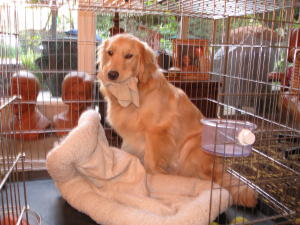
Barbara The Marathon Runner got some new running socks for Christmas, and she put them in a tidy little pile with some other presents. And then, magically, they disappeared.

Well, we’ve learned where to look when socks disappear — in Callie’s crate! Sure enough, that’s exactly where they were.

I love Callie’s attitude about her crate. She’s the first dog I’ve crate-trained, so I wasn’t sure what to expect after we met the basic goal of house-training her. That accomplished, Callie uses her crate a lot — voluntarily. Most of the time, the door is open, so she’s free to come and go. Sometimes, she’s fed in her crate, but not always. Her water dish, always full of fresh water, is in her crate. Frequently, she sleeps in her crate for part of the night, but not always; it’s her choice.

Maybe more important, many of her toys “live” in the crate. Callie doesn’t always put them there; sometimes we do. But many times during a day, Callie walks into her crate, selects a toy, and carries it in her mouth to another part of the house. It’s fun to try to figure out why she chooses a particular toy. In the case of “Stinky,” her stuffed doggie security object, it’s obvious. She retrieves Stinky every night before bedtime, so she can suck on it and “wind down.”

So maybe it’s not surprising that, when Callie finds a wayward pair of socks, they end up in her crate. I think it’s cool that she feels some sense of ownership toward her crate. She probably thinks “a dog’s crate is its castle,” so that it should be off-limits to humans. And we generally respect that, except when it comes to missing running socks.

Give Your Puppy a Head Start!

Tuesday, December 22nd, 2009

thumb.51PTcover

“He is your friend, your partner, your defender, your dog. You are his life, his love, his leader. He will be yours, faithful and true, to the last beat of his heart. You owe it to him to be worthy of such devotion.” Anonymous quote, from “51 Puppy Tricks,” by Kyra Sundance.

You will want to hear Kyra Sundance tell how to train your puppy! Learn Kyra’s specific techniques and how to teach your puppy the “Ring a Bell to go Outside” trick.

Dogbonding: How to create a stronger bond with your dog

Monday, December 21st, 2009

“Dogbonding” is a process of building a close relationship with your dog.

If you would like to have a closer relationship with your dog, you will want to remember some of the pointers in this article.

Much of dog training is about obedience – getting your dog to pee outside, not chew the furniture, come when called, etc. This kind of training is obviously important. You might save your dog’s life by getting it to “come” away from the path of a speeding car.

To achieve the full potential of your relationship with your dog, though, you need to get past obedience training and into activities where there is true interaction – give and take at your pet’s level.

Every day, Callie, my Golden Retriever, and I play soccer together. When Callie arrived at our house as an eight-week-old puppy, she squatted down behind an old soccer ball. She looked me in the eye as if to say, “OK, Fred, show me what you’ve got!” Since then, we have played soccer almost every day. My kicking has improved, and Callie has advanced from trapping the ball under her tummy to leaping in the air to do “nosers” – Callie’s version of a “header.” We interact in the same way that you would if you were practicing soccer with another person.

The essential ingredient of my soccer experience with Callie is that it was her idea – her invitation. And every day, it’s Callie who invites me — rather, “begs me” — to go outside and play soccer. She finds me in the house, makes eye contact, and turns to run outside. Then she stops and looks back to see if I am following her. If I am not cooperating, she lopes back to my side and starts again with the eye contact.

As a concession to “alpha” theory, I initiate the game by bringing the soccer ball out of its storage place, and I finish the game by putting the ball back where it belongs. But the game itself is an equal give-and-take between Callie and me.

This is where “dog-bonding” can come into conflict with some modern theories of dog training. Proponents of “all alpha all the time,” for example, put the emphasis on the owner being “top dog.” These people admonish dog owners “never to play tug-of-war with their pet.”

But tug-of-war can be a great give-and-take game to play with your dog – provided that (to make the “alpha” folks happy) it isn’t taken to the point that the dog’s behavior becomes aggressive. Next time your dog brings you a toy, or some other object, take it in your hand, but don’t wrench it away from your dog. See what it wants to do. And then try letting the dog decide the game. If it wants to play “give and take,” let it. If it wants to play “tug-of-war,” let it – without allowing your dog to become aggressive. You might find that your dog wants to play “let’s just both hold this for a while.” It seems to give them lots of satisfaction.

There is definitely a place for “alpha.” It’s just overdone sometimes. When Callie was a puppy and jumping up on our three and five-year-old granddaughters, we asked dog trainer Brian Lee for help. In two hours time, Brian worked magic with Callie, and part of the solution was not letting her sleep on our bed. This was subtle, but it seemed to reinforce some family hierarchy in Callie’s mind.

Some of my other favorite dog-bonding moments are:

• Callie’s daily “good morning” ritual. When she sees that I am awake, she walks to my side of the bed, drapes her nose on the edge of the bed, and “snorts” (literally) until I scratch her neck for a while. It’s a very special dog-bonding way to start the day.

• Our morning jog is always a shared adventure. Callie does a good job of “heeling,” but sometimes she asks politely if she can greet a friend – sometimes a favorite doggie friend, sometimes a favorite people friend.

• During the day, when I am working in my office, Callie is always close. Several times a day, she walks into my office, puts a paw on my knee, and asks for a little attention. Sometimes, she snorts, which is her way of getting my attention. Sometimes it’s a very short snort, but sometimes she continues to snort, as if she is trying to mimic human conversation. It’s very charming.

And it’s not just about dog-bonding with me. Callie has a great relationship with one of her favorite people friends, Jeff, a greens-keeper at the nearby golf club. Callie absolutely adores Jeff. Sometimes, Jeff endears himself to Callie by presenting her with a tennis ball, but Callie would love Jeff even if there were no tennis balls. If he can afford the time, Jeff gets out of his golf cart and gives Callie a nice scratch on her chest.

Ted Kerasote, author of “Merle’s Door,” and a guest on my talk show, suggests letting your dog “read the news” on your morning walk. He says, “I spend ten or fifteen minutes reading the news every morning; why not let Merle do the same thing?” By “reading the news” Ted means letting your dog have plenty of time to sniff around your neighborhood. That’s a dog’s way of knowing what’s been happening in its world. Try it; your dog will love you for it!

Another guest on the “My Doggie Says…” talk show, Kyra Sundance, has published several books about how to teach your dog tricks. Teaching your dog tricks is an excellent way to spend some quality time with your dog – and improve your relationship. You and your dog learn together, and your dog will appreciate the time you spend with it – and the attention it gets from you.

Invent your own forms of dogbonding. The important thing is to share experiences with your dog; to do things that it enjoys doing. It will be grateful to you for spending the time, and you will find your doggie relationship moving to a higher level.

New CD Coming Soon: "Dog Appreciation Lessons: Humor and Wisdom from People Who Love Dogs"

Tuesday, November 24th, 2009

haney_cd_sm

This informative and entertaining CD gives dog lovers a deeper appreciation for the magic of dogs. And it helps them build a stronger bond with their pet.

Since I started broadcasting the “My Doggie Says…” radio talk show, I have conducted in-depth interviews with over 75 well-known dog experts — authors, dog trainers, researchers, and people who work with dogs in their daily lives. These people have shared some wonderful insights into their relationships with their dogs and the real meaning of having a close relationship with your pet.

This new CD captures some of the special moments in these interviews. It compresses over seventy-five hours of interview time into about forty-five minutes of doggie wit and wisdom.

Coming soon in the mydoggiesays.com “Store.”

Here is a listing of the tracks, along with some sample sound files:

“Dog Appreciation Lessons” CD Track List

1. Opening

2. Ted Kerasote, author of “Merle’s Door.” Ted meets Merle.

3. Bob Worley and Max the Motorcycle Riding Dog

4. Belinda Abbott, DVM: The Idatarod dogs

5. Kyra Sundance teaches the “chase your tail” trick

6. Interview with Barley, a rent-a-dog

7. Nick Dodman, author of “The Well-Adjusted Dog”: Dog body language

8. Stanley Coren: The intelligence of dogs

9. David Frei, co-host of the Westminster Kennel Club Dog Show: “Angels on a Leash”

10. Dean Koontz: “Don’t take my dog to jail.”

11. Gordy Leitz and Owen Keefe: Trusting a police K-9 dog

12. Tom Davis, author of “Why Goldens do That”: Hunting with dogs

13. Dave Reaver, importer of K-9 dogs: Dogs are not a “deadly force”

14. Tom Sullivan, author of “If You Could See What I hear”: Believing in a guide dog

15. Ted Kerasote: How dogs “read the news”

16. Mary Lou Jennings, Phoenix Children’s Hospital: A therapy-dog success story

17. Dean Koontz: Being in a special relationship with a dog

18. Tom Sullivan: Nelson, a guide dog, finds a hotel room four years later

19. Jeff Pokonosky, dog rescuer, swims the Alcatraz race with Jake, his Labrador retriever

20. Closing

The “My Doggie Says…” show helps listeners gain a deeper appreciation for “Man’s Best Friend.” The show is broadcast live from 8:00 to 9:00 p.m. on Wednesday nights, on KFNX 1100, Phoenix. It is streamed live on www.1100kfnx.com. Host Fred Haney interviews dog whisperers, dog trainers, authors of dog books, and experts on all aspects of dogs and dog behavior and dog nature. The show is also available as a podcast on iTunes. Go to the iTunes store, click on “Podcast,” and search for “My Doggie Says…”

Check out the dog-relationship books written by all of the authors who have appeared on the “My Doggie Says…” show.

How Do You Deal with a "Damaged Dog"?

Friday, November 13th, 2009

How do you deal with a dog that is so seriously “damaged” that you can’t even approach it? Listen to Debbie Jacobs, author of “A Guide to Living and Working with a Fearful Dog,” as she shares her experience in working with Sunny, a “seriously damaged dog.” This book represents a very high level of understanding of dog behavior and dog training.

The “My Doggie Says…” show helps listeners gain a deeper appreciation for “Man’s Best Friend.” The show is broadcast live from 8:00 to 9:00 p.m. on Wednesday nights, on KFNX 1100, Phoenix. It is streamed live on www.1100kfnx.com. Host Fred Haney interviews dog whisperers, dog trainers, authors of dog books, and experts on all aspects of dogs and dog behavior and dog nature. The show is also available as a podcast on iTunes. Go to the iTunes store, click on “Podcast,” and search for “My Doggie Says…”

Check out the dog-relationship books written by all of the authors who have appeared on the “My Doggie Says…” show.

Also, remember to take our on-line poll: “How does your dog show affection for you?”

Training Without Dominance: A Guest Post by Dr. Susan Wright

Friday, November 6th, 2009

If you have had an interest in dogs for any length of time, you’ve no doubt heard the comment that dogs are a pack animal, and you need to be the alpha, or leader, in your dog’s pack or it won’t respect and obey you.

This “dominance theory” method of training is popular with followers of some well known dog trainers who are often featured in the media. They use techniques such as the “alpha roll”, where a dog is rolled over onto its back in a submissive position, to establish their position as pack leader.

Certainly there are a number of ways to train a dog, and this method may appear to work in some cases, but do we need to use such an assertive, dominant method to teach our dogs to behave?

Not according to the American Veterinary Society for Animal Behavior (AVSAB). Their position statement specifically states that the idea that dogs are pack animals and have a dominance based hierarchy just isn’t true. Furthermore, research on wolves in the wild indicates that their pack isn’t strictly controlled by one single alpha dog either.

That’s not to say dominance behavior between dogs doesn’t happen. It does, but it occurs when two animals are competing for a scarce resource, such as food. So, unless you’re trying to eat your dog’s kibble before he does, there’s no real place for a dominance type approach to your relationship with your dog.

According to the AVSAB, training your dog using dominance methods may result in him being afraid of you. Your relationship will be antagonistic and adversarial, and it will be based on fear and intimidation.

I know I don’t want my dog to be afraid of me. I want to have a partnership with him, where I teach him what I want, and he does his best to do what I ask. I want a bond with him so when he sees me, he wags his tail with delight, rather than tuck it between his legs in anxiety. That give and take relationship is what makes a dog man’s best friend.

What’s the alternative to dominance training?

Think about the trained dolphins in the marine parks, jumping through hoops and somersaulting in the air. These dolphins in the wild also establish dominance between the members of their pod. Do the dolphin trainers use any dominance techniques to teach these mammals to jump? No, they use a positive training method known as operant conditioning, where the dolphin learns that doing the right thing results in a whistle and a fish.

We can do the same thing with our dogs. Using a clicker, and food rewards, we can gently and positively shape our dog’s behavior so that he learns exactly what we want from him. By doing this, rather than punishing or dominating him when he does the wrong thing, we’ll learn to work together, with no relationship-destroying intimidation.

There are other things you can do to maintain a close and mutually respectful relationship with your dog. Don’t yell and scream when you’re angry, it will frighten him. You should be the one to feed him because if he sees you as a source of food, he will regard you in a very positive light. Similarly, spending time grooming and playing with him will allow you to share pleasant times and good fun, both of which will bring you closer.

If a trainer can teach a large marine mammal to jump into the air without force, compulsion or domination, we should be able to train our dogs in the same way. There’s no place for dominance in our relationship with our dogs. Take the time to look for alternatives – your dog will appreciate it.

This guest post is brought especially to you by Dog Fence DIY’s staff veterinarian Dr. Susan Wright. Dog Fence DIY has a variety of electric fences for dogs at the best available prices. Dog Fence DIY helps you choose the right system for you and your pet, helps you install it, and helps train your pet to use the new system.

Learn About "Puppy Love" on the "My Doggie Says…" Radio Talk Show

Wednesday, October 14th, 2009

Liz Palika, award-winning author, dog trainer and pet expert talks about her new book, “Puppy Love,” on the “My Doggie Says…” radio talk show. Liz also discusses her approaches to dog training.

Click here to see Liz’s other books; she is a prolific writer about dogs!

The “My Doggie Says…” show helps listeners gain a deeper appreciation for “Man’s Best Friend.” The show is broadcast live from 8:00 to 9:00 p.m. on Wednesday nights, on KFNX 1100, Phoenix. It is streamed live on www.1100kfnx.com. Host Fred Haney interviews dog whisperers, dog trainers, authors of dog books, and experts on all aspects of dogs and dog behavior and dog nature. The show is also available as a podcast on iTunes. Go to the iTunes store, click on “Podcast,” and search for “My Doggie Says…”

Check out the dog-relationship books written by all of the authors who have appeared on the “My Doggie Says…” show.