Archive for the ‘Books’ Category

Dogs (including Callie) like to drink cold, running water

Thursday, October 18th, 2007

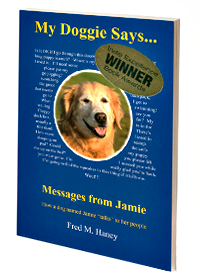
One of the fun things about watching a puppy grow up is that you see their raw instincts, unspoiled by human influence, learned behaviors, etc. The point of “My Doggie Says… Messages from Jamie” is that you can get much closer to your dog by observing its behavior and learning to decode its messages. I’m finding that it’s easier, in some ways, to understand Callie’s (now nine months old) messages, because they are so clear and based mostly on her natural instincts.

Callie has made it clear, from the time she was about four months old, that she prefers fresh, cold water over water that has been sitting in a bowl. How does she express this? Sometimes when I walk her outside for a pee break, she stops at the metal water bowl in the kitchen for a drink. Even though she always has a water bowl in her crate. Her message is, “This water seems fresher and clearer to me.”

After all, dogs are ancestors of wolves, who roamed the forests and learned the hard way that cool water from a babbling brook is better and healthier than water from a warm stagnate pool.

When we interrupt our morning jog for a water stop, Callie prefers to drink water being poured into her water dish, rather than drinking from the dish.

Here’s a short video that shows 1) Callie drinking water as it’s being poured into her water dish and 2) Callie drinking from a water fountain on the path to her boat dock at Lake Arrowhead.

httpv://www.youtube.com/watch?v=Q128IYTyFvk

And here, on the same subject, is an explanation of why dogs like to drink from a toilet bowl.

There are a number of dog and cat “running water” drinking dishes and fountains on the market, to satisfy our pets’ instincts for fresh water.

Based on Callie’s polite requests, I change the water in her crate frequently, so that she always has fresh, cool water to drink. And she shows her appreciation by sending me a big doggie “Thank You.”

A Bear in a Gift Shop (Is that anything like a bull in a china shop?)

Tuesday, October 16th, 2007

You already know that the Wishing Well at Lake Arrowhead Village was one of Jamie’s (My Doggie Says…) favorite places. She used to drag us into this charming little gift shop because of the doggie-friendly water bowl and the HUGE puppy treats. Not missing a beat, Callie has made the same discovery. Here, from My Doggie Says…, is Jamie straining to get another puppy treat.

wishing_well_store_img_0423-2.jpg

Because proprietress Mary Kelly is used to a steady stream of furry dog-friends in her shop, she didn’t pay much attention when a different kind of furry friend wandered in — a one-hundred pound bear cub.

Fortunately, Mary, a true lover of animals, knew not just to give the cub lots of space, but also to get the help of Wildhaven Ranch, a Lake Arrowhead-based animal rescue and rehabilitation organization managed by Diane Dragotto Williams. Wildhaven Ranch tries to protect and rehabilitate local animals, but they are also a shelter for animals (like bears) that have become “imprinted” by humans. Once an animal becomes “imprinted” it can lose its ability to forge for itself in the wild. Or, worse, it can become a threat to people.

So the Wildhaven folks know how to deal with these situations in order to protect people, but also to protect the bears from becoming imprinted, which, according to Diane, can be a death sentence for the bear.

Here’s the whole story in the Mountain News.

It’s fun that two of my favorite “mountain ladies” are both a part of this story.

I’ve written before about Wildhaven Ranch (August 13 blog). These people are true animal lovers. To me, one of their noblest efforts is the attempt to educate people about the dangers of “imprinting” wild animals. Often this happens because someone feels sorry for the animals (a bear in this case) and decided to feed them. This might be well-intentioned, but it makes the bear dependent on the person doing the feeding and can lead to “imprinting.”

Sometimes, the best way to love an animal is to let its own breeding and genetics have their way. This is often the case with our dogs, as well.

Exercise helps a puppy calm down

Tuesday, October 9th, 2007

The worst thing about being away for nine days was having to leave Callie behind. When we travel, Callie is in the good hands of Carter Patrick Carrigan, pet sitter. So we know she’s well cared for, but it was hard to leave her behind for so long.

Coming home, it was amazing to see how much Callie had calmed down in nine days. Most of this was because she’s a little more mature. She did get daily doggie walks with Carter, but not the three or four mile walk she gets most mornings.

Before we left for vacation, Callie was still bouncing off the walls. She had moments when she would lie down with her little stuffed “stinky” puppy (security object), but the next minute she would be jumping on Barbara and me, the furniture, Okie-Dokie the cat, and anything else she could find.

But yesterday Callie got her three mile walk, and in the evening, she was a different doggie. We were able to give her the run of (most of) the house, and she was extremely well behaved.

She took a little nap in my office in the afternoon. Then she took turns playing with several of her toys. She ran up and down the hallway a few times, but she was very calm.

Then in the evening, she was free to go from my office to the kitchen. She relaxed and played with toys in the kitchen for a while. Then she flopped down on the hearth in the den (while we watched Cleveland beat the Yankees) and just relaxed.

Some of the “new Callie” is just a puppy growing up and maturing. But some of it is a result of the daily exercise she gets. We had a similar experience with Jamie (“My Doggie Says… Messages from Jamie. How a dog named Jamie ‘talks’ to her people”). Jamie also ran at least three miles every morning, and it helped her to be a very relaxed and mellow Golden Retriever.

One difference is that Callie’s vet doesn’t want her to run until she’s fourteen months old, to give her hips plenty of time to become strong. She is only about ten months old, so Callie is walking three miles, or more, while Jamie was running three miles every day. But for a puppy, a three mile walk seems to be enough to help her be a calm doggie.

If you’re not used to running, or walking, three miles every day, think of your daily doggie walk as a partnership. You’re helping your dog stay calm, and your dog is helping you lose weight.

Here’s a fun article about how you and your dog can have fun losing weight together.

Rules dogs live by: Enjoy little pleasures like a wood fire

Sunday, September 30th, 2007

One of Jamie’s Rules is “Enjoy little pleasures like a wood fire.” Part of having a closer relationship with your dog is to understand its “little pleasures” and help it experience them. Here’s Jamie enjoying one of her favorite things:

ch2_0022-2.jpg

Jamie was also very thoughtful about “where to be.” Sometimes, like Don Juan, the Yaqui Indian Shaman, Jamie would walk around until she found just the right place, and just the right angle, to flop down. She seemed to get great pleasure from experimenting and finding the “perfect” place. Sometimes, it would be to get some fresh air, or to lie on a cool surface on a warm day. Another time, at Lake Arrowhead, it would be to get positioned to watch the squirrels running on our deck. On one very warm day, she plopped herself down in front of a fan to enjoy the cooler air.

ch14_img_4343-2.jpg

Here is one of my favorite photos of Jamie. She’s enjoying “The Pinnacles” a small range of mountains near Lake Arrowhead.

final-pdfs-for-book-068-2.jpg

I’ve written about Callie’s “stinky” toy (security object) and how she can spend hours snuggling with it, or gently “gumming” it. But sometimes she brings it to me as a way of initiating play. She will hand it to me (with her mouth) and then we “hand” it back and forth. Sometimes, it becomes a very gently form of tug-of-war, but it always stays very gentle.

Become more aware of your dog’s little pleasures, and help it enjoy them. It will help you build a strong relationship with your pet.

It’s OK for a dog to be afraid sometimes

Friday, September 28th, 2007

One of “Jamie’s Rules” from “My Doggie Says…Messages from Jamie: How a dog named Jamie ‘talks’ to her people,” is “It’s OK to be afraid sometimes.” You can see some other “Jamie’s Rules” here.

After I finished writing My Doggie Says…, I went back through Jamie’s “messages,” asking myself, “What do Jamie’s communications tell me about her philosophy of life?” Each of Jamie’s Rules is based on some of Jamie’s messages.

Jamie, at age 10 1/2, when the book was written, had worked her way through some, but not all of her fears. But Callie, as an eight-month-old puppy, is still working her way through a lot of fears.

Jamie’s greatest fear, as an adult dog, was thunder storms. When I was writing My Doggie Says…, we had a huge thunder storm, and Jamie absolutely freaked out. She ran outside, and then raced back inside to avoid the heavy downpour of rain. She jumped up on the bed. Then she jumped down and tried to dig a hole in the carpet. She was just miserable.

We solved the problem by going into the den, closing all the windows & doors and turning the TV volume up to drown out the sound of the thunder.

Callie, though, as a puppy, is still working through a lot of different fears. It’s fascinating to watch her do this. When she confronts something she doesn’t understand, she stops and watches closely and tries to figure out what’s happening. You can just see the “wheels going around” in her mind as she tries to understand.

In these situations, I am always careful to let her have time to deal with her fears.

Here’s a fun little video clip of Callie when she was learning to swim. You see her being afraid of the (very small) waves, pawing at them to size them up. Then she tries a second time to reach out to the toy she’s retrieving. But then, instead of swimming to the toy, she grabs the rope and pulls the toy ashore. Now, of course, she’s pretty much past this fear, and she jumps right in to swim.

httpv://www.youtube.com/watch?v=KXotuLVPzxc

Almost every time I take Callie outside to pee, she stops to figure out what’s going on. The other day, there were lots of sounds — several birds chirping and squawking, a car driving down the street, the sound of workmen hammering a few doors away, and the sound of leaves rustling in the wind. It took Callie a minute or so of standing quietly and letting her senses work to process all of this and get comfortable proceeding to the side yard.

Last weekend, at Lake Arrowhead, Callie and I went out in the dark for a little pee walk. Through the dark night, Callie saw the outline of a toppled-over trash can. At first, she didn’t know what she was seeing. She stopped cold and just looked. And then, interestingly, she pulled me toward the can, overcoming any fear she had and moving in to check it all out.

Another time, at a fundraising event at Lake Arrowhead, Callie stopped for several minutes to figure out a chamber music quartet. And another time, we went for a walk in the night, and the full moon was casting strong shadows on the street. Callie stopped for a minute to get comfortable with the moon shadows.

So, it’s OK for dogs to be afraid sometimes, and your dog will appreciate it if you help it — or at least give it time — to overcome its fears.

Callie goes to puppy kindergarten (Video Part 1)

Friday, September 21st, 2007

Yesterday was Callie’s third session at Puppy Kindergarten. She goes to the Lomita Obedience Training Club classes, and her teacher is Ethel Mercer, one of the people who wrote a pre-publication review for “My Doggie Says… Messages from Jamie.

In these segments, Callie (and Barbara) work on “sit,” “recalls,” and “sit when distracted.”

This is clicker training, so the trainer is being trained just as much as the dog. The clicker is used to reinforce positive behavior and to say “a treat is on the way.” So the trick is to give a command, get the desired response from Callie, “click,” and then give a treat. When you’re holding a leash, a clicker, and puppy treats all at the same time, it’s a challenge to keep it all coordinated.

You’ll see that Callie has some good success. But she’s still a puppy, and she bounces around a lot. She doesn’t always stay focused. But it’s fun to watch her progress.

She did a couple of good “sits” when she was being distracted. This is good discipline for a puppy to learn. Sometimes they have to obey commands when things are confusing.

Hope you enjoy the video. Sorry about the noise in the background; you’ll see the lawnmower going back and forth.

httpv://www.youtube.com/watch?v=AT0zsgiXzoY

In case you can’t play the video, here’s some alternative entertainment on Ramblings of a Pheasant Plucker. It’s called “Dog Logic.” It’s a collection of twelve fun “dog sayings.” Example: “If your dog is fat, you aren’t getting enough exercise.”

Do you know what your dog is asking for?

Wednesday, September 19th, 2007

The second of Jamie’s Rules (from “My Doggie Says… Messages from Jamie”), is “Ask for the things you need.” Here are a few of Jamie’s other rules.

Dogs are pretty good at asking for the things they need, but sometimes we have to “listen” pretty hard to get the message. Their messages are usually sent with body language, not verbally, although a loud bark works for some things.

Here’s Callie saying, Please come play soccer with me. The messsage here is not real hard to understand, but it caught me totally by surprise the first time she did this, because she was just eight weeks old, had just arrived at our house, and we had never played soccer before. How did she figure all this out?

img_5498-4.jpg

Callie, still only eight months old, is learning how to ask for things. One day, for example, as we walked by the big water dish in the kitchen, she dragged me over to it so she could get a huge drink of water. I had to “put two and two together,” but the message was, “I need fresher water in my crate.” She had a water dish in her crate, but she felt that the water in the kitchen was fresher — and it was.

Jamie took “ask for the things you need” to its sublime limits. She had lots of ways of asking if she could stop, on our morning jog, to retrieve a pine cone. Usually, she would just stop by a pine cone and make eye contact. Other times, she would stop and “point” at the pine cone. Either way, the message was pretty clear.

Callie can jump up on our bed, but Jamie had ACL surgery, so she couldn’t jump up. She asked to be lifted up by doing this:

final-pdfs-for-book-019-2-redo.jpg

Jamie also became a master at getting people to scratch her in her favorite places. She would snuggle up against a visitor’s leg, for example, inviting an ear scratch. Or she would push her nose into someone’s hand, asking for a nose scratch, or, even better, a chest scratch.

Jamie also got very good at asking to go outside to go pee, or asking for a puppy treat, or for her dinner. All of these were done with body language, so we had to pay attention and learn what she was trying to tell us.

Finally, Jamie was a pretty good “route planner.” She knew all of our jogging trails, including the ones at Lake Arrowhead. Here she is saying, “Let’s go toward the boat dock so I can play with my water “Floppy” (floating frisbee toy).

final-pdfs-for-book-091-2.jpg

Anytime your dog does something a little different, you have to stop and think, “Is my dog trying to tell me something?” “Is it asking for something?” What’s the message? To “hear” what your dog is “saying,” you have to become observant. Try putting doggie-two and doggie-two twogether. It’s fun.

Dog talk works both ways

Sunday, September 16th, 2007

I was the speaker at a local event yesterday, and a member of the audience said, “Didn’t you write a book about how to talk to your dog?” (I get this question often.) My answer was, “No, it’s about your dog talking to you!”

It’s important to remember, if you want to have a close relationship with your dog, that relationships — and communication — work two ways. You talk to your dog, and your dog talks to you. The problem is, you and your dog probably speak different languages.

My Doggie Says… Messages from Jamie” is a collection of photographic (color) examples of the messages my Golden Retriever, Jamie, sent as part of her every-day communication. The point of the book is that, by observation, you can learn to understand your dog’s messages, which are almost always sent by “body language.”

Much of our training (and reading) about how to work with our dogs focuses on teaching them to respond to certain commands, like “sit,” “stay,” “down,” “speak,” etc. Callie (Jamie’s successor) is going through this “puppy kindergarten” training right now (Lomita Obedience Training Club) The focus here is on sending messages to your dog, including using a “clicker” to tell your dog, “A yummie puppy treat is on it’s way!” The clicker reinforces the puppy treat reward for good behavior, and it is becoming an important part of sending messages to your dog. (Here’s a good article on “clicker training.”)

But the other side of communication is learning to listen to what your dog is saying, which really means observing your dog’s behavior and figuring out what messages it might be sending.

Here, from 101-dog-training-tips.com, is a good article on the subject of dog communication and body language. Once you get better at understanding your dog’s body language communication, you will also get better at using your body language to communicate with it.

For example, when your dog or puppie jumps on you, you can try to correct it by yelling “no” or “wrong,” but the “dog body language way” is to either turn away (expressing dissatisfaction) or follow the advice of this article from The How-To Lounge. It suggests grabbing your dog’s front paws and forcing it to stand on it’s hind legs, which it will not like. You release the front paws after a few seconds and say “OFF.”

To have a closer relationship with your dog, make sure you’re speaking (and hearing) it’s language.

Talking About Dog Talk

Wednesday, September 12th, 2007

For our newer readers, this is a repeat of the introductory post, so you get the flavor of the My Doggie Says… blog. I’m travelling. Back Thursday.

Does your dog talk to you? Can you tell what it’s saying? I spent the last five years photographing my Golden Retriever and capturing some of her body language messages. The result is a book titled My Doggie Says…: Messages from Jamie. How a dog named Jamie talks to her people. The web site for the book is www.mydoggiesays.com. In this blog, I plan to share some of the stories from the book. Also, everywhere I go these days, dog-lovers want to have fun conversations about their dogs and how they “talk” to their owners. So I plan to share some of these stories, too. You will also meet a four-month-old Golden Retriever puppy named Callie (short for Callaway) (short for Woodland’s Callaway Hole-in-One). I will post pictures of Callie as she grows up. One of Callie’s favorite things is to play soccer. I’ll post some pictures of Callie playing soccer in the next few days.

Please share your “dog-talk” stories with me and the other readers. Our pets communicate with us more than a lot of people realize. My Doggie Says… has helped a lot of people become more aware of their pets’ communications skills.

Happy Dog-Talking!

When do you stop crate training? Callie comes out of the crate.

Sunday, September 9th, 2007

Callie is the first dog we’ve “crate trained.” Here are a few articles on how to crate train a dog: “Crate Training a Puppy or Adult Dog.” “Confinement and Crate Training,” the San Francisco SPCA.

We’ve been very pleased with the results, but we weren’t sure what the “end game” would be. Does Callie have to live in the crate forever? When would she be free to run around the house? Will she want to go back to the crate on her own?

Well, the last two nights answered some of these questions. We decided on Friday night to let Callie sleep on our bed. So we left the crate door open, and, sure enough, she jumped up on the bed and slept on the corner where Jamie used to sleep. Here, from My Doggie Says…, is a picture of Jamie sleeping on our bed:

ch16_0011-2.jpg

Callie did just fine, except for bouncing off the walls — and me — for the first two or three minutes. But she settled down and had a good night’s sleep on the bed.

Last night was different. She jumped around for a few minutes and finally settled down on her corner. But, at about midnight, Barbara asked, “Is Callie still on the bed?” I took a look, and she wasn’t. She had jumped off the bed and snuggled up in her crate!

This made me feel really good about the crate. She obviously sees it as “her” place, and she was comfortable sleeping in it, even though she could go anywhere in the bedroom. This also started to make me feel better about the “end game.” So maybe there really will be a time when Callie has the run of the house & yard but will choose to spend some time in her crate because it’s “her home.”

Then, at about 2:00 in the morning, Barbara (asker of all questions), said, “Is Callie still in her crate?” So I checked (being the answerer of some questions) . Callie wasn’t on the bed, and she wasn’t in her crate. She had snuggled by the sliding glass door, with her nose right in the open crack of the door — getting lots of nice fresh night air.

I thought this was wonderful. One of my doggie fascinations is, “How do dogs decide where to be?” One answer is certainly “near nice fresh air.” But this is another topic.

And then, when it was time to get up, we noticed that Callie had moved to the floor by Barbara’s side of the bed. Callie had an adventurous night — starting to sleep on the bed, moving to her crate, then some fresh air and, finally, snuggling up close to Barbara.

Somehow, it all felt really good. It validated some of the crate theory — that she liked it well enough to choose to sleep there for a while. But it was also fun to see her making her own decisions about “where to be.”