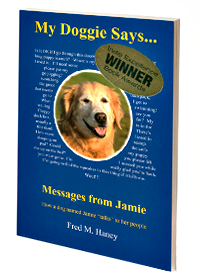
Archive for the ‘Books’ Category

More Stinky News

Thursday, September 6th, 2007

As I reported before, my three-year-old granddaughter, Lauren, has a stinky. Actually she has about three stinkies, because one of them is usually so stinky that it needs to be washed. Sixteen-month-old Granddaughter Amelia has also started to use one of Lauren’s stinkies. Here’s Amelia with a borrowed stinky.
img_1429-2.jpg

The stinky, or security blanket was popularized by Linus in the Charles Schultz Peanuts cartoons. Psychologists call these things security objects. Here, from Wikipedia, is some background on security objects. At least as they pertain to children. The article says that they can help children adapt to new situations and aid in their learning. This seems to work for dogs, too.

Jamie (My Doggie Says…) used a red, blue and yellow stuffed ball as her “stinky.” She kept it nearby most of the day. And at night, she often carried it into our bedroom to park it a few inches from her nose. She didn’t chew on it a lot; she just kept it close. Sometime, she talked to it in a high-pitch, whinie voice. But when her ball got lost forever, Jamie was depressed for several weeks. She had obviously lost an important part of her life. Here’s Jamie with her ball:

ch4_0028-2.jpg

Callie’s stinky is her little stuffed dog. She carries it around and gently chews on it frequently. But especially at night. Almost every evening, she finds it and gently “gums” it just before bedtime. Sometimes for thirty or forty minutes. It seems to put her in a very peaceful mood — ready for a good night’s rest.

img_6588-3.jpg

Monday morning, at Lake Arrowhead, Callie was looking for her stinky. I could see that she realized it was still downstairs in the bedroom. So she ran down two flights of stairs to look for it. Realizing that it was still in her crate, with the door closed, I followed her down. Sure enough, she ran right to the crate. I opened the crate door, and Callie ran in, collected her stinky puppy, and ran back up two flights of stairs to enjoy it.

Callie inherited her stinky puppy from Jamie, but it wasn’t really a security object for Jamie; it was just another toy. It’s amazing that, after about six months of chewing on it, or “gumming” it, Callie hasn’t shredded it. She’s very gentle with it.

Callie does something with her stinky puppy that I’m not sure I understand. Jamie did the same thing. She will offer it to me, almost like a gift. I’ve seen her offer it to her doggie cousin Ishka, too. She offers it, but she doesn’t really let go. I’m reluctant to force her to “give” the puppy to me, because I don’t really think she intends to give it to me. And I don’t think she wants to get into a tug of war. So I usually hold onto it for a minute, while she’s still got it in her mouth. Then she seems happy to walk away and enjoy it again. It’s almost like she’s offering to share her most precious thing with me, but just a litle bit.

Watch your dog and see if you can figure out which toy is its stinky. Which toy does it play with the most? Which toy does it play with at bedtime? If it does have a stinky, then be aware that it might be extremely important to your dog’s good emotional balance to spend time with it. If it gets lost, help your dog find it.

It will appreciate your help more than you can know.

Luca the launch ramp perro

Wednesday, September 5th, 2007

The Bay of San Quentin (Bahia de San Quintin) is a large, natural bay on the Pacific Coast of Baja Mexico. It’s about a four hour drive from the border town of San Ysidro, just south of San Diego. It’s a coastal and saltwater environment rich with wildlife, including California grey whales, gazillions of pelicans and terns, and lots of baitfish to attract large species of fish, like white seabass, yellowtail, halibut, calico bass, and many species of “rock fish.”

There’s no real harbor, right now, for boats. Fishing boats are either trailered in from outside the area, or they are chartered from one of the many local skippers.

The center of fishing activity seems to be the Old Mill Restaurant, a large building constructed by Dutch settlers to mill local grains and, more recently, turned into a restaurant and neighboring hotel. There is one other hotel, a few tackle shops, a few boat charter offices, a fish-cleaning palapa, a pier that is being reconstructed, and a launch ramp for the fishing boats, whether trailered in from outside or chartered locally.

The evening Brad, my son, and I arrived for a few days of fishing, we were greeted by Luca, the launch ramp dog. Luca is a very attractive boxer. When I first met him, I didn’t who owned him, or if he even had an owner. But I knew Luca was a very social dog. The night we arrived, Luca walked over, sniffed our hands, and escorted us as we walked about a quarter mile to Don Eddy’s restaurant. Luca walked side-by-side with us all the way and then said hello to some other fishermen after we arrived at the restaurant.

The next morning, at about 5:00, I made a quick run to the tackle shop to see about buying a few Krokodiles (metal jigs for catching fish). As I arrived at the shop, a truck pulled up to the Old Mill Restaurant, and out hopped the owner, the chef, and Luca. So now I knew who Luca belonged to.

Later that day, after our fishing trip, I saw Luca with two doggie friends — a German Shepherd and a mutt. The three dogs were being very friendly, licking each others’ noses. Once again, I was impressed at how social and friendly Luca was. It was very clear that Luca was the alpha animal of this small pack. He started the sniffing, and he ended it.

When we went to watch our fish (yellowtail, ling cod, calico bass, red rock fish) being cleaned under the palapa, there was Luca checking out the day’s catch. He surveyed the fish-cleaning papapa, and then he stood at my side for several minutes, as if to say, “not a bad catch, Fred, but no white sea bass; too bad.”

As our trip progressed, I noticed that Luca worked the whole area from the fish-cleaning palapa to Don Eddy’s, never missing an opportunity to greet a new group of fishermen, quick to welcome patrons to the Old Mill Restaurant, and right on top of all the activities at the launch ramp.

Luca is a great ambassador for Bahia de San Quintin!

How do dogs and people relate?

Tuesday, August 28th, 2007

There are lots of things you can do to have a closer relationship with your dog. “My Doggie Says…” is sort of a training manual for observing your dog, learning to understand what it’s saying, and nurturing it. This can bring you into a much closer relationship with your dog.

But what does it mean to be in a relationship with your dog? Does it just mean that your dog responds to “sit,” “stay,” “come,” and “roll-over?” Or is there something more going on? Is there some kind of emotional connection between people and their dogs? It sure feels that way to me.

People who really love their pets are often accused of “anthropomorphizing,” or imagining that their dogs behaviors represent human emotions or actions. If my dog licks my hand, is it because he loves me? Or is it because the salty flavor tastes good? But do dogs “doggiepomorphize?” Do they assume that people think like dogs? Probably. You could explain some of the “pack behavior” training theories this way.

Here’s a very thoughtful piece on this subject by Jasper: The Blogging Lab. After all, Jasper’s a dog, so he should know the answers to these questions.

Jasper believes there’s more to the people-pet relationship than anthropomorphizing. Here’s what he says:

Personally I believe that there has always been much more to the canine mind than what we have in the past permitted ourselves to perceive. Believing this is no longer the wishful thinking of a pet owner anthropomorphizing their own thoughts onto those of their dog’s. Rather, dogs have recognizable intelligence.” Jasper also points out that scientists are discovering that dogs do have “recognizable emotions.” These emotions come into play in “pack” interactions. Why not also in human interactions?

Here are some thoughts I especially like:

“When I’m sad, they (my dogs) snuggle and are gentle and loving, not playful or rough. When I share good news with them, they respond by jumping around or by bringing me one of their toys. To me, this illustrates in the dog, a certain degree of intelligence and emotion, as well the ability to read, understand and interact with us.”

Yesterday, I talked about how much I enjoy my soccer games with Callie. She sits in the back yard, just on the other side of the soccer ball from me, and waits for me to come and play. How long would she sit there and wait? I don’t want to know, because after about thirty seconds, I start to feel guilty — like I’m hurting her feelings if I don’t play. Would it hurt her feelings if I didn’t respond? I have to believe it would, and it would begin to “train” her to not invite me any more.

So whether Callie is feeling human-like emotions or something else, I’m not going to “hurt her feelings.”

What to do when your dog invites you to play?

Monday, August 27th, 2007

You PLAY with your dog; that’s what you do. Why not reward your dog’s initiative?

Yesterday I came home after a very frustrating round of golf (in a tournament at my club), and I just wanted to sit down in the back yard with a beer and some cheese and crackers — mostly so I could cry in the beer.

And then I look up and see this, or at least a slightly more current version of it. I say “more current version” because Callie has gained about twenty five pounds since this photo was taken.

img_5353-3.jpg

Callie would stand there for an hour, I think, waiting for me to play soccer with her. And I guess she has me right where she wants me, because I can’t “just sit there” when she’s making such a lovely invitation.

Here’s what our soccer games look like.

[youtube = http://www.youtube.com/watch?v=u4jkyC40njo]

As Callie matures, the nature of the game changes a little. She doesn’t stop to munch the grass and bushes as much as she used to. And, tragically, she’s almost too big now to squeeze through the orange tunnel. She can make it, but it’s pretty funny to watch her push the ball through. I guess we need to look for a bigger tunnel.

The other change is that her tummy is higher now than it used to be. So it’s easier for me to kick the ball when she traps it under her body. So sometimes she tries to pinch the ball between her front legs, or her hind legs, to make it a little harder. She’s a real competitor! (But I’m careful not to let the game get to a point where she becomes aggressive or real excited.)

Like Jamie (“My Doggie Says…“), Callie is good about drinking lots of water, both before and after her exercise. When she knows it’s time for a walk, she goes to her water dish for a nice big drink. But there’s an interesting difference. Jamie was always content to drink water from a bowl. Callie will drink water from a bowl, if it’s fresh, but she prefers to drink water that’s being poured or squirted, like water coming out of a fountain. When we stop in the middle of our walk to give Callie some water, she likes to drink from the stream of water as we pour it from the bottle into her dish. Like Jamie, she also likes to drink from the neighbors’ water sprinklers. And if we fill the water bowl in her crate by drizzling water in from above the crate, she drinks from the stream of pouring water instead of from the bowl.

All of which is a comment on how dogs’ breeding preserves some of the most basic instincts for survival. If you’re out in the wilds, of course it’s better to drink running water than stagnate water. If you want to push this a little farther, you can buy a small fountain that creates a running stream of water for your dog or cat. I just get a kick out observing the differences between Jamie and Callie, both of whom were purebred Golden Retrievers.

Is your dog inviting you to play? What are you waiting for? What better way to nurture your relationship?

Callie's Dog Talk: "Would someone please put some water in my puppy water dish?"

Friday, August 24th, 2007

Does your dog talk to you? If it did, would you know what it’s saying? That’s really what “My Doggie Says…” is about — listening and observing and trying to figure out what your dog is telling you.

Last night, Barbara and I went outside for our pre-bedtime Jacuzzi (or Cajjuzzi, as granddaughter Lauren would say). Just as we got into the water, we heard four loud barks from Callie.

Now, this is pretty amazing all by itself, because we’ve only heard Callie bark three of four times. A few weeks ago, we were starting to wonder if she even had a voice. But she did bark at some raccoons at Lake Arrowhead and another time when a neighbor’s dog walked by off the leash. So it was surprising to hear Callie bark so loud and so emphatically.

Right away we wondered “what could be the problem?” She was in her crate, inside the house, with a sheet draped over it for the night. She has gotten tangled up in the sheet a time or two, so that was a possibility. The only other things I could think of, as I got out of the Jacuzzi, were that she was stuck in the crate somehow, that she wanted to come outside, or that her water dish was empty.

When I pulled the sheet back, Callie was standing up with her nose by her water dish, which was totally empty. I thought, “it sure looks like Callie was asking for a puppy water refill.” I filled the dish to the brim, closed the crate door, and pulled the sheet back over the crate.

And that was the end of the barking. I got back in the Jacuzzi, and Callie didn’t say another word. She was just saying, “Please fill my puppy water dish!”

It’s hard to understand what a dog is saying, sometimes, but it’s very rewarding when you figure it out. Sometimes you just have to think, “what are the different things he/she could be saying under the current circumstances?”

Think how good it makes your dog feel when you do finally “get the message.”

Back to the basics of having a good relationship with your dog.

Friday, August 24th, 2007

I like to find ways to have a closer relationship with my dogs. The main message of “My Doggie Says…Messages from Jamie. How a dog named Jamie ‘talks’ to her people” is that, by observing your dog’s behavior, you can gain a better understanding of your dog. And then, of course, you have to act on what you learn.

Right from the first day Callie arrived at our house, when she was eight weeks old, she has invited me to play soccer with an old, under-inflated soccer ball. So I make time to play soccer with her. Here she is, waiting inside her tunnel, to see which direction I’m going to kick the ball.


mvi_0290_0001-3.jpg

And here she is in action:

img_5411-3.jpg

But it’s important to pay attention to the basics, too. Here, on eSecret, is a good article titled “Are you a Good Dog Owner?” The keys, according to this article are 1) giving your dog lots of exercise, 2) rewarding and complimenting it often, 3) having structured training times, 4) having your dog groomed several times a year, and 5) giving your dog lots of social interaction with both dogs and people.

We work hard at giving Callie lots of exercise (long walks, soccer games and swimming), plenty of positive feedback, and lots of dog and people social interaction. We do work with her on the basic commands, but we can learn to be more structured about it.

It’s just about time to enroll Callie in Puppy Kindergarten. We’re hoping we can get her in a class with the same instructor who helped us learn to train Jamie (the heroine of “My Doggie Says…”). Her name is Ethel Mercer, and she works with the Lomita Obedience Training Club. See the web-link in the right-hand sidebar of this blog.

A message from Callie: The top ten things your dog won't tell you.

Tuesday, August 21st, 2007

Hi! My name is Callie. I’m a seven-month-old Golden Retriever. Usually Fred is writing about me, but he’s traveling for a few days and he asked me to share some doggie secrets with you. So, off the record, I thought I’d tell you ten things that your dog probably won’t tell you. Here we go!

1. I chewed a hole in the leather sofa today.

2. That expensive dog food you’re buying for me tastes great, but the cheap stuff would be healthier for me.

3. I can tell you like the cat better than you like me.

4. The pet-sitter lets me pee on your backyard grass.

5. The $.25 puppy treats you get me are way better than the $1.50 ones.

6. You don’t really have to buy me Christmas presents.

7. I really feel stupid wearing that pair of doggles (doggie-goggles) you bought me.

8. When I snuggle with you on your bed, I’m pretending that you’re a really sexy black lab.

9. You just think you’re the alpha animal around here. Who’s giving whom everything they need?

10. There’s a little surprise for you in the middle of the kitchen floor.

This was fun. I hope Fred lets me do it again sometime!

Bye,

Callie

Build a stronger relationship with your dog by understanding its breeding

Monday, August 20th, 2007

Callie is a Golden Retriever, and Golden Retrievers were bred to retrieve. (Surprise!) Actually, they were bred in Scotland to retrieve shot game (mostly birds). On this morning’s walk, Callie started by carrying a dirty old wadded-up sock. Then she found a piece of eucalyptus bark about five feet long. She tried dragging that for a while, but it was pretty hard. Then she found a nice fresh jack pine cone. She wanted to stop and play with it, but I was able to get her to carry it while we kept walking.

After a while, Callie got tired of the pine cone, so she walked along looking for something else to retrieve. This time it was a stick about four feet long. She kept trying to carry one end of it, which made it hard to carry. Finally, she jiggled it in her mouth until it was more-or-less balanced, and she carried the stick for while. Then she spotted another pine cone and decided to trade the stick for the pine cone.

If you know what your dog was bred to do (and not do) you can build a better relationship with it. You can help it do the things it was bred to do. Or, at least, you can provide opportunities for it to do the things it was bred to do. The essential message of “My Doggie Says…” is that you have to understand your dog’s “nature” in order to “nurture” it.
Here are some other characteristics of Golden Retrievers, according to Wikipedia:

“Golden Retrievers are usually compatible with children, adults, and other dogs. They typically bark when startled, but generally their friendly nature makes them poor guard dogs. Golden Retrievers are particularly valued for their high level of sociability towards people, calmness,and willingness to learn. Because of this, they are commonly used as guide dogs, moblility assistance dogs, and search and rescue dogs.[1]

In addition to “retrieving,” Golden Retrievers are very social animals. We’ve been trying to give Callie every opportunity to socialize with people in our neighborhood, the men who work on the golf course, and other dogs we meet on our walks. Most of the time, it’s Callie who initiates these fun little encounters. But we encourage and support them.

Notice that if you’re looking for a guard dog, you should look to another breed. A Golden Retriever would probably greet a burglar with open arms and a wagging tail before barking a warning!

Wikipedia has detailed information on the breeding of over 500 different breeds. So it you’re not sure what your dog was bred to do, check it out. It’s fun, and it can help you reinforce your dog’s breeding and natural personality.

What did this dog talk really mean?

Friday, August 17th, 2007

Steve wrote a very cute “Dog Talk” post at myspace.com. He tells about adopting a dog, and then he “translates” the dogs actions into English based on what he found when he got home after leaving Buckshot home alone. Some examples: “I’m sure he won’t mind if I just tug on the corner of this sheet some.” And, “Ooh, was that sound the sheet ripping? Oops.” And, “Hmm, what’s this? A foam filled mattress! Yay!”

It’s a cute, but disastrous little story.

The real message Buckshot was sending was probably, “Man, I need Steve to take me for a three mile walk every morning. I’m just a bundle of energy, and if I don’t have a good way to burn it off, I’ll chew on everything I can find.”

Sometimes it’s hard to decipher a dog’s messages.

This excerpt from “My Doggie Says… Messages from Jamie — How a dog named Jamie ‘talks’ to her people” illustrates the point:

“One morning, during our jog, Barbara and I ran to a nearby shopping plaza to buy four copies of a local newspaper. (Barbara’s picture was in the paper.) I rolled the four papers into a bundle about the size of a small loaf of bread, and we started the jog home (about one mile). Several times, Jamie looked back at me, as if to get my attention. Barbara said, “She’s trying to say ‘hello’ to you.” But the fourth time, Barbara said, in amazement, “She’s not saying ‘hello.’ She wants to carry the newspapers!” So I put the roll of papers in Jamie’s mouth, and, sure enough, she proudly carried them the rest of the way home.”

ch18_001d-2.jpg

I enjoyed Steve’s story and the way he translated the dog talk into English. But I think the deeper message is, “Hey, Pal, help me burn off some of this excess energy. Then I’ll be gentle as a lamb & just lie here all day & dream about pretty girl doggies!”

Dog goes off the deep end (Callie jumps into Lake Arrowhead)

Wednesday, August 8th, 2007

Well, after a few days (spread over a few weeks) of training, Callie took the plunge off the dock into the depths of Lake Arrowhead. She handled it well, but she still has some work to do.

She started by warming up with a few swims & retrieves (of her “floppy disk” from the shoreline). It had been two weeks since her last swim, so she had to get back into the feeling of swimming. The first time we tossed her Floppy into the water, very close to shore, she didn’t go right after it. Instead, she ran back and forth on the shoreline, not quite having the courage to tackle the massive (six inch) waves of Lake Arrowhead. We could see her trying to get up the courage to go into the deeper water, and finally she “just did it.” It’s pretty astounding to watch her work hard at overcoming her natural fears.

So then we decided to give her a try off the end of our boat dock. In case you’re wondering “why all the fuss?” the problem here is that there is some boat traffic near our dock. We didn’t want to have Callie in the lake until we were sure she would come when called. And that she would “fetch” her Floppy every time and “bring” it back.

For these first few test dives, I wanted Callie to be on a leash, so I hooked her up to a thirty foot lead. This would give her plenty of room to swim, but it let me reign her in, in case of an emergency.

So with Barbara in the water, Callie and I walked to the end of the dock. She walked like she was desperately eager to jump into the lake. But when we got to the end of the dock, she stopped short. She looked over the edge of the dock (which is about two feet above the water) and acted like she wanted to jump, but she couldn’t quite bring herself to take the leap.

She tried reaching down to the water with a front paw, but she couldn’t quite reach it. This went on for a few minutes, with Barbara and me encouraging her to jump in. Finally, she just lost her balance and fell in! It wasn’t pretty, but there she was in fifteen feet of water. It only took her a few seconds to start paddling, and then she was fine.

She swam to her Floppy, retrieved it, and swam with Barbara back to the shoreline (about sixty feet). Success!

So we tried again, and Callie had the same problem getting up the courage to jump off the dock. We let her work at it for a few minutes, and then I gave her a very gentle nudge. This time, as she realized she was falling forward, she pushed off with her hind legs and made a beautiful four-legged entry into the water. What a champ! She retrieved her Floppy and swam it back to shore again.

That was enough for one day. She did great, but she will get stronger at swimming as she gets more practice. She’s a great swimmer for a six-month old puppy, but she’s nowhere near as strong as Jamie was (or any full grown Golden Retriever).

Here are a few photos of Callie retrieving her Floppy:

img_6115-3.jpg

img_6121-4.jpg