Archive for the ‘Relationships’ Category

Announcing the "My Doggie Says…" Radio Talk Show

Saturday, May 10th, 2008

The first My Doggie Says… radio talk show aired at 8:00 p.m. Mountain Standard Time on Wednesday, May 7. The show is broadcast by KFNX 1100 in Phoenix, and it is streamed over the Internet. The show will continue for at least twelve more programs, each running from 8:00 p.m. MST/PDT to 9:00 p.m. MST/PDT on Wednesday nights.

The first show, which consisted of four ten-minute segments will be posted in MP3 format on the new and revised www.mydoggiesays.com web site, which should be completed in the next few days. If you would like to hear the first show, go to www.mydoggiesays.com and visit the “Media Room” page. I’m not exactly sure when the new site will go live, but it should be this coming week.

If you’d like to listen to the show and you’re not in Phoenix, KFNX streams their programming over the Internet. You can hear the show in real time by going to www.1100kfnx.com and clicking on the “Listen Live” button in the upper righthand corner of the home page.

The My Doggie Says… talk show will address many of the same subjects we discuss in this blog — dog-talk, dog-relationships, improving our dog-listening skills, and nurturing our dogs’ personalities. And Callie will have a feature: Callie’s Corner.

Those Amazing Doggie Noses

Sunday, April 27th, 2008

You already knew that dogs have an incredible sense of smell. They have about 25 times as many smell receptors as humans, and they can sense odors at one-hundred-millionth the concentration that would be required by humans. Click here for an interesting summary of doggie olfactory capabilities.

But this article from MSNBC provides some amazing examples of how dogs’ super-sensitive-sniffers are being used to solve some real-world problems.

The University of Washington’s Center for Conservation Biology uses dogs to sniff out “doo-doo” (scat) from different species of animals — and specific animals within a species — in order to track their movements and, in some cases, solve some important mysteries.

For example, the researchers were able to determine the effects on whales of some Navy sonar testing by having the dogs collect the whales’ scat before and after the testing. They were able to learn about any changes by examining different hormone levels in the scat.

Head researcher, Samuel Wasser, says the dogs are a little hyper compared to other dogs. They are highly motivated, on their scat searches, to find something useful, because they love their reward — 90 seconds of play with the other scat-finding dogs.

In California, the dogs were able to distinguish between 1,300 kit fox scat samples. In Africa, the dogs were able, with the help of DNA samples, to find the elephants from which ivory tusks had been poached. In the Pacific Northwest, two of the dogs are helping scientists track levels of PCB (a banned industrial substance) in the scat of Orca Whales.

A really neat slide show accompanies the MSNBC article. It has 8 images of the dogs at work and the ivory tusks that were poached.

So, next time you walk outside with your dog, don’t be surprised if it sticks its nose up in the air and checks out the smells for a few seconds. After all, it can smell things in microscopic concentrations (almost one billionth) compared to what you would need to detect an odor.

A Dog's House (Crate) Is It's Castle (Isn't It?) (by Callie, Golden Retriever)

Saturday, April 19th, 2008

So here I am feeling all happy and excited because I’m getting a lot more freedom these days. Fred and Barbara are letting me wander pretty much anywhere around the house, except in the living room. And I come across this really nice, wet, juicy wash cloth. What’s a Golden Retriever to do, but retrieve? Isn’t that what I’m supposed to do?

But something inside me said, “This is not a good thing to do. Fred and Barbara are not going to be happy.” So I snatched the juicy gem as fast as I could and ran into my crate.

A doggie’s crate should be it’s castle, shouldn’t it? Sort of like an American embassy in a foreign country on a little piece of American soil. So isn’t my crate a protected doggie sanctuary in the middle of Fred and Barbara Land?

Well, I thought so, but guess what? BUSTED! Fred reached right into my doggie sanctuary and grabbed the wash cloth out of my mouth. I didn’t make it easy for him, but he was able to get it. He said something about, “What if you swallow the thing, Callie?”

That’s twice, now, that I’ve been busted on my own private piece of land. On April Fool’s Day, I grabbed one of Barbara’s socks and ran into my crate, thinking I’d be safe. But guess again. Poor Callie; no place to hide.

It’s funny. I love the freedom I have to roam around the house & just hang out. But I really love my crate, too. Sometimes it feels good to just go in there to get a drink of water or just to lie down and rest for a few minutes. This crate-training stuff is OK.

Bye for now.

Callie

Which Person Are You, Labrador Retriever? (By Dr. Callie, Golden Retriever)

Saturday, April 12th, 2008

Dr. Callie

I know, I know, the patient is supposed to be on the couch, and the psychologist is supposed to be in the arm chair. But I couldn’t find a patient. Where are those Labrador Retrievers when you need them?

You may have read that there’s a new book that helps people figure out, if they were a dog, which dog would they be? Here’s a link to the article. The book is called, “Which Dog Are You?”

There are also some sites where a person can take an on-line test to see which dog they are. Here’s an example at www.ivillage.com.

Well, if people can have a “which dog are you?” book, I decided my doggie friends should have a “which person are you?” book. So I decided to start writing it, and I thought I’d use myself as an example for the first chapter. You can see it here.

This time, we’re going to talk about Labrador Retrievers and see which person they are likely to be like.

According to the AKC, Labrador Retrievers are kindly, outgoing and of a tractable nature. (Can’t you just hear the guy at the dog shows reading this stuff?) They are also supposed to be easy to please, gentle, intelligent and adaptable.

By my doggie psychology calculations, lots of Labrador Retrievers are “ESTPs.” This means they see a world “outside themselves.” Like a lot of dogs, they are very oriented toward their highly efficient senses. They are “sensors” more than they are “intuitors.” Their intelligence often makes them “Thinkers” (as opposed to “feelers”) Their action orientation gives them a tendency in the direction of “perceiving,” as opposed to “judging.” So, Labrador Retrievers are often ESTPs.

There’s a joke titled, “How Many Dogs Does it Take to Change a Light Bulb?” You can see it by clicking on this link. There’s an answer for lots of breeds. But the answer for the Labrador Retriever is very revealing of their personality: “Oh, me, me!!! Pleeeeeeeze let me change the light bulb! Can I? Can I? Huh? Huh? Huh? Can I?” If that’s not an ESTP, I’ve never seen one. (Although I suppose a few could slip over into ESFP.)

According to my Dr. Doggie text books (my doggie friends, you can learn a lot about this stuff at www.personalitypage.com), ESTPs are generally action oriented, flexible and adaptable, fun to be around, and good natured. Does that not sound like every Labrador Retriever you ever met?

So, dear Labrador Retriever, if you want to know what kind of people-job you might have, your qualities would make you an excellent sales representative. Your strong sensory processing, your outgoing nature, and your enthusiasm all come into play here.

Your qualities also make you an excellent candidate for police or detective work. Duh! No wonder so many of our friends are already employed this way. You could also be a paramedic. (Not sure they allow doggie wound-licking)

Finally, you, dear Labrador Retriever, should be very comfortable as an entrepreneur. Again, your outside-world view, your sensory abilities, your intelligence, and your action-orientation all make this a good path for you.

Who knows, maybe someday you’ll write a blog, like me.

Bye for now,

Dr. Callie, Golden Retriever

What If Your Dog Says Something Important And You Don’t Understand It?

Thursday, April 10th, 2008

This article, from the North Kitsap Herald in the state of Washington, is a perfect example of what can happen if your dog sends a message and your can’t figure it out. It’s a story about dog trainer Dianne Canafax and her dog Roofus. Roofus woke Canafax out of her sleep one night with lots of loud whimpering and barking. Canafax didn’t figure out what Roofus was “saying,” until the next morning, when she found big clumps of bear hair stuck to a tree outside her window. Read the entire story by clicking here.

So how often do our favorite pets go unheard? My guess is that this happens more than most of us would like admit. The problem is that dogs speak a different language than humans. We humans have to work pretty hard to understand what our furry friends are saying.

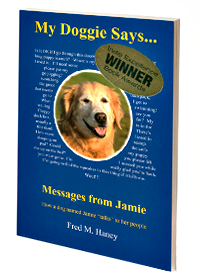
This is what my book, “My Doggie Says… Messages from Jamie: How a dog named Jamie ‘talks’ to her people” is about. Recognizing when a dog is communicating and trying to figure out what it’s saying.

If you need proof that dogs send subtle and hard-to-interpret messages, try this on for size. According to research done by Turid Rugas, dogs have about thirty “calming signals.” These are signals used in the wolf pack (back when dogs were wolves) to say “OK, guys, can’t we all get along? Let’s calm down.” One of these signals occurs when a dog quickly lips its nose with its tongue. This may be a sign that the dog is feeling some stress and is either trying to calm itself, or it is asking you to “cool it.” If you walk directly toward a dog and make eye contact, a dog might use this calming signal. Such a direct approach makes a dog nervous; they prefer more of a circular or sideways approach.

One of my favorite stories from “My Doggie Says…” illustrates how hard it can be to interpret a dog’s communication.

One day, on our morning jog, we ran past the local newsstand to buy four copies of a newpaper because it contained Barbara’s (my wife’s) picture. I rolled up the four copies and we started to run about a mile back to our home.

After a few minutes, Jamie looked back over her shoulder at me. She made eye contact, and it was clear that she was “saying something.” We talked about it, and Barbara suggested, “I think she wants you to pay attention to her.” So I stopped and gave her a big doggie ear-scratch. And on we went.

But Jamie wasn’t satisfied. We went through the doggie ear-scratch thing again, and then we looked at each other and said, “Jamie doesn’t just want attention; she wants to carry the newpapers!”

I gave her the roll of newpapers, and she ran proudly and happily the rest of the way home. After all, she was a Golden Retriever.

Our present Golden Retriever, Callie, sends lots of messages, too. Recently, she’s been using her voice to try to communicate with grunts and snorts. It’s almost as if she’s trying to talk people-talk. Sometimes, the message is pretty obvious — like saying at 2:00 a.m. “I need to go outside to pee.” But sometimes we just can’t figure out what she means.

I have a little list of Callie messages that I’m still trying to understand.

It’s great fun to try to understand your dog’s messages. Some are very subtle, like the calming signals. Some are pretty obvious like a wagging tail, or perky ears. But dogs send a lot of “action messages.” They do this by just doing something. You’ve probably seen your dog do this. Out of nowhere, it does something a little unexpected — or maybe very unexpected.

If it’s not obvious, you have to ask yourself, “Why did Rover do that? What’s he trying to tell me?” It’s fun to interpret these messages, and your dog will be very appreciative. It will probably be a better adjusted dog, too, because it knows your trying to understand it and meet its needs.

Callie's April Fools Joke

Wednesday, April 2nd, 2008

Callie, my fourteen-month-old Golden Retriever, has been “crate trained.” It’s the first time we’ve crate-trained a dog, and it’s worked great. Now, as she gets more mature, we’re giving her more time outside the crate. She’s even slept on our bed a few nights without disrupting our sleep too much.

But the last few weeks, she’s had to sleep in her crate again, because Barbara had some surgery and we don’t need Callie, in her exuberance, opening up Barbara’s stitches.

So yesterday morning, April 1, we were quite surprised when, out of nowhere, Callie ran across our bedroom and went straight into her crate. She was free to run around the house, but all of a sudden she bounded into her crate and sat in a perfect pose, at attention.

This was one of those “why-did-she-do-that?” moments that can make “dog-talk” such a challenge. How do you figure out what your dog is saying?

When we looked closer, we got the message. Callie was sitting there with Barbara’s running socks in her mouth. She was saying, “April Fools! I’ve got your socks and you can’t touch me in my crate because it’s off-limits to people.”

Needless to say, we collected Barbara’s socks, but we quickly replaced them with one of Callie’s prized toys, and she forgave us for encroaching on puppydom.

Most of the time, when a dog does something unusual, there’s a message. The problem is to figure it out. This one wasn’t too hard to interpret, but it was a fun April Fools!

My Dog Really Wants To Join Your Soccer Game

Monday, March 31st, 2008

Sometimes doggie-messages are pretty easy to understand. Here’s an example of some dog-talk that was not hard to interpret.

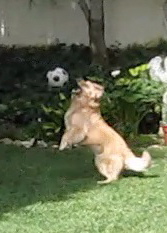
Callie, as you know, is a soccer dog. She just loves to play soccer with me. And the thing I love most about it is that it’s Callie’s “invention.” When she was still a puppy, she would invite me to play soccer by standing behind the ball, as if to say, “OK, Fred, show me what you’ve got!”

Here’s an update on Callie’s soccer skills, photographed recently by Barbara:

[youtube]httpv://www.youtube.com/watch?v=H2g1WBcnpx4[/youtube]

That’s all by way of background so you can understand what happened yesterday, when Callie went for a walk with Lauren and Amelia, our two grandchildren.

As we walked along, we could hear a brother and his sister practicing soccer in their driveway. They were kicking the ball to each other, and, occasionally, kicking it into a “goal” on their garage door.

When we got to the driveway so we could see the two soccer players, Callie froze in place. She sat down and watched the two kids with so much intensity that she started to quiver. At that moment, there was nothing in the world she wanted more than to join in the soccer practice. It showed in every bone in her body.

My heart really ached for her, because I knew exactly what she was thinking and how much it meant to her. For a minute, I truly wished I could just take off her leash and let her run & join the soccer game. She would have chased the ball down and trapped it under her tummy. Or, she might have done a few “nosers,” doggie versions of the “header.”

But then, of course, reality set in. Dog off the leash. Scared kids, who don’t know that Callie is a good soccer player. And so forth.

It just made me vow to make sure Callie gets to play soccer more often and to honor her very polite requests for a soccer game in our back yard.

Goodbye, Charlie (by Callie)

Tuesday, March 25th, 2008

img_0992-3.jpg

I learned this morning that one of my favorite Golden Retriever friends, Charlie, was hit by a car and killed a little over a week ago. So I’m feeling just terrible — for the loss of Charlie and for Charlie’s step-brother, Mooch, and his owners, Doug and Sonja.

I could tell something was terribly wrong this morning when I saw Doug walking with Mooch but without Charlie. Mooch has always been friendly with me, but not as exuberant as Charlie. But this morning Mooch explained to me, in doggie language, what had happened. Mooch was very broken up about it, and I feel sorry for him. He’s obviously very depressed.

The relationship between Charlie and Mooch is pretty fascinating. Doug and Sonja got Charlie, a rescue Golden Retriever, a few years ago, because Mooch had disappeared. But then someone took Mooch to a vet, who scanned his micro-chip and returned him to Doug and Sonja.

My sincere and doggie-heart-felt condolences to Doug, Sonja, and Mooch for their loss. You never quite know how bonded you are to a pet (or to a person) until you lose them. Which is too bad, but I guess that’s just how it is.

Sometimes it’s really frustrating not to be able to talk like a person — using my voice. I’ve been trying lately, but I think, to Fred, it just sounds like a bunch of “snorts” and “grunts.” I’ve tried a few times when I had something important to say, like, “could I please get out of my crate for a while,” or “isn’t it about dinner time?” But these were always short messages.

Today I walked into Fred’s office and tried for about five minutes to explain to Fred how I felt, in people talk. I know all Fred heard was “grunts” and “snorts,” but I actually think he understood what I was trying to say. Fred was so heartbroken that he cried, too, when he heard the news. So I’m pretty sure he understands how I feel and that he shares my feelings. We rubbed foreheads for a minute, so I felt we were almost able to communicate like dogs.

Here’s a web site that has a lot of beautiful poems that might give comfort to someone who recently lost a beloved pet. One of Fred’s favorites is “Dinah in Heaven,” by Rudyard Kipling.

Goodbye, Charlie. I really love you.

Callie

My Dog Found Five Bucks!

Monday, March 24th, 2008

Callie, now a fourteen-month-old Golden Retriever, but still a puppy in many ways, works very hard at the “leave it” command. This command is not just intended to get her to “let go” of something. If you’re quick enough on the draw, you can use the “leave it” command to keep her from picking something up in the first place.

I’m really more interested in building my dog relationship with Callie than in beating commands into her, but “leave it” is important. It can be a lifesaver.

On our morning jog, a Golden Retriever has many temptations. There are some good things to be retrieved — like sticks and pine cones. But there are also some things better not retrieved — mostly stuff that occasionally flies out of a car window. Like a candy wrapper, a sales slip, or a packing peanut. Since some of Callie’s jogging is on a golf course, she’s also tempted frequently by a grass divot — a hunk of grass and dirt that got gouged out of the golf course by a swinging golf club.

She’s pretty good at “leave it,” if we see an offending piece of trash and yell “leave it” before Callie gets to it. But, much as we try to avoid this stuff, Callie still gets the jump on us sometimes. Occasionally, she sees some scrumptious looking piece of garbage before we do, and she’s learned to make a quick stab before we can react. So, we’ve also gotten pretty good at prying her mouth open and reaching way down into her throat to eliminate the hazard.

On Friday, she totally beat us to the “trash” with a lightning fast stab before anyone could utter the words “leave it!” But imagine our surprise when we reached down to the bottom of her throat and pulled out a nice, crisp five dollar bill! Who would have guessed?

How would you train a dog to only retrieve paper currency? Are there any one-hundred-percent indestructible dog toys that we can buy for five bucks?

BTW, “My Doggie Says… Messages from Jamie, the dog book I wrote about Callie’s predecessor, Jamie, just won its fourth award — a Silver Medal for non-fiction (Adult Books) in the Mom’s Choice Awards. There’s a nice review on their web site.

Decisions, Decisions, Puppy Decisions (by Callie)

Wednesday, March 19th, 2008

img_0569-2.jpg

You know, I don’t usually have to make a lot of decisions. Barbara and Fred decide a lot of stuff for me. Like when I get to eat, when we go jogging, what time we go to bed, and stuff like that.

Sometimes, I do decide to take a nap. And sometimes it’s hard to figure out which toy to play with, because I do have a lot of toys.

So yesterday I’m walking down the hallway and Okie-Dokie the black cat goes walking by. That cat can be really arrogant. It walks with a swagger, and I swear it’s always telling me, “ha, ha, I never have to be in a crate!” Or “cats are better than dogs.”

Actually, Okie-Dokie and I have become pretty good friends. We like to rub noses, and sometimes I lick Okie-Dokie’s head. She seems to like that. But I really like to pester her sometimes, so it only took me a millisecond to decide to run down the hallway and pounce on Okie-Dokie — just to see how loud she would “hiss!”

But just as I started after Okie-Dokie, Barbara showed up at the other end of the hall in her jogging clothes and wearing her jogging fanny-pack. Uh-oh! Slam on the brakes! Given a choice between annoying Okie-Dokie and going jogging, I’ll always go for the jog. It’s much better exercise than pouncing on cats. Besides, I can go cat-pouncing just about any time I want.

So I stopped myself in mid-pounce and ran over to Barbara so she could put my leash on.

It wasn’t a real hard decision to make, because I really like to go jogging, but it made me realize that my life is pretty simple most of the time. Eat, sleep, pounce on cats, pee, pooh, and eat some more.

But you know what I really look forward to? The times when Fred and Barbara play with me and make me feel part of the family. Lots of times, I start the play by presenting them with one of my favorite toys. Then we play a game of “let’s both hold this for a while.” It’s my favorite game, next to playing soccer with Fred.

I’m getting to spend lots more time out of my crate, so I do have to make more decisions than before. But mostly it’s deciding NOT to eat the rugs. Things seem to work better that way.

Next time!